
If you have searched for Monterey pine removal rules in Oakland, you have probably already discovered that this species behaves nothing like the oaks, bay laurels, and buckeyes that dominate most discussions of the city’s tree ordinance. Monterey pine sits in a unique legal category alongside eucalyptus, and understanding exactly what that exemption does and does not cover is essential before you schedule any work. Just as important, and frequently overlooked entirely, is the biological reality that most mature Monterey pines in the Bay Area today are infected with a fungal disease that has no cure and that fundamentally changes how this species should be assessed, pruned, and ultimately removed.
This guide explains exactly what makes Monterey pine removal different in Oakland: the specific legal exemption and its limits, the notification requirement that still applies, the development-related exception that surprises many property owners, and the pitch canker disease that should inform every decision about timing and method. If you have a Monterey pine on your Oakland property, our ISA-certified arborists at Oakland Urban Tree Care provide assessments that account for both the legal and biological sides of this species.
The Legal Difference: Why Monterey Pine Is Exempt
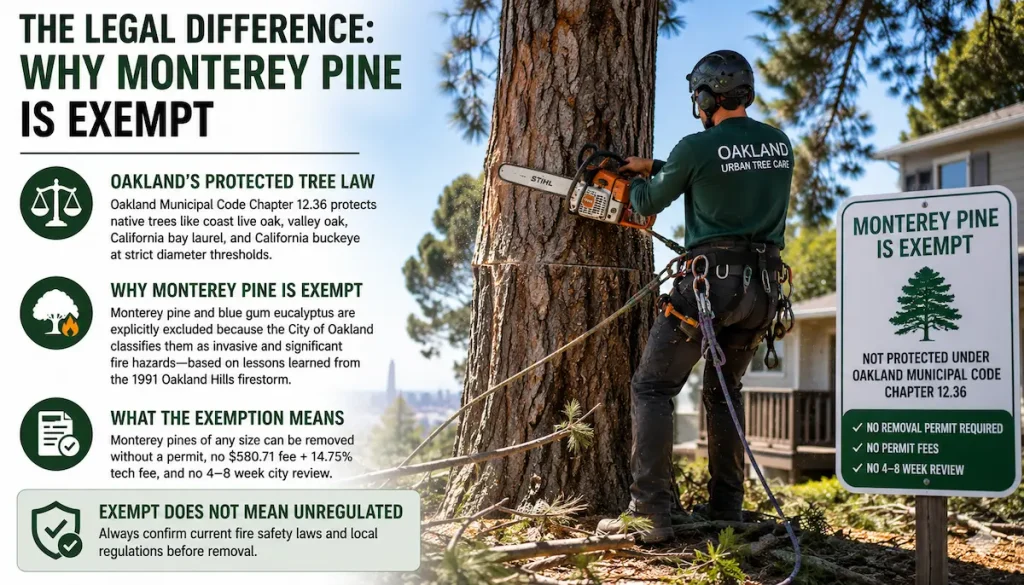
Oakland Municipal Code Chapter 12.36, the Protected Tree Ordinance, protects native species including coast live oak, valley oak, California bay laurel, and California buckeye at strict diameter thresholds. Monterey pine and blue gum eucalyptus are explicitly excluded from this protection regardless of trunk size. The reasoning behind this exemption is documented directly in city policy: both species are classified by Oakland as invasive and as significant fire hazards, a designation rooted in the aftermath of the 1991 Oakland Hills firestorm, in which extensive eucalyptus and pine groves were identified as having contributed to the fire’s explosive spread.
This exemption status was explicitly confirmed in the city’s own public statements during the high-profile Claremont Avenue enforcement case decided in 2026, in which Oakland officials clarified that property owners need permits to remove trees of a certain size except for most eucalyptus and Monterey pine trees, which are considered invasive and fire hazards. The Claremont Avenue case itself, which resulted in proposed fines approaching one million dollars, involved primarily coast live oaks and big leaf maples rather than pines, precisely because the pines on that property would not have triggered the same enforcement exposure.
What the Exemption Actually Means in Practice
In practical terms, a Monterey pine of any trunk diameter on your Oakland property can be removed without submitting a Non-Development Tree Removal Permit application, without paying the $580.71 base fee plus 14.75 percent technology fee that applies to protected species, and without waiting through the standard 4 to 8 week city review timeline. This is a meaningful practical and financial advantage compared to removing a coast live oak of similar size, where both the fee and the wait apply regardless of the tree’s condition.
The Notification Requirement That Still Applies
Exemption from the permit process does not mean Monterey pine removal in Oakland is entirely unregulated. Any property owner or arborist who intends to remove one or more Monterey pine trees from a parcel must notify the city’s Office of Parks and Recreation in writing, stating the address, the number of trees, and the size of the Monterey pine trees to be removed. This notice must be addressed to the Tree Reviewer, Park Services Division, 7101 Edgewater Drive, Oakland, CA 94621.
Why This Step Gets Skipped and Why That Is a Mistake
Many property owners and even some tree service companies assume that exempt means no paperwork of any kind, and they skip the written notification entirely. This is technically a violation, even though no permit fee or formal review applies. While enforcement of the notification requirement alone is rare compared to enforcement against unpermitted removal of protected species, skipping it removes your documentation trail. If a removal is ever questioned, whether by a neighbor, a future buyer’s title search, or a code enforcement inquiry, having the written notification on file is the simplest proof that the work was done in compliance with city process. Our team submits this notification as a standard step on every Monterey pine removal we perform in Oakland, regardless of how routine the job appears.
The Development Exception Most Homeowners Do Not Know About
There is one specific scenario where Monterey pine loses its blanket exemption, and it catches many property owners by surprise during larger projects.
More Than Five Trees on a Development Lot
If a lot is being cleared specifically for development and more than five Monterey pine trees are being removed as part of that clearing, a permit is required, unless the lot is larger than one acre. This exception exists because large-scale removal of mature pines as part of a development project has a meaningfully different ecological and neighborhood impact than a single homeowner removing one or two problem trees from a residential yard. If your project involves clearing a lot with a stand of six or more Monterey pines and your parcel is under one acre, plan for the standard permit process on this portion of the work even though Monterey pine is generally exempt.
Clearing for Reasons Other Than Development
If the same lot with six or more Monterey pines is being cleared for a reason unrelated to development, such as fire risk reduction, tree health concerns, or general property maintenance, no permit is required regardless of how many pines are removed. The distinction hinges entirely on whether the clearing is connected to a development project. Our lot clearing and multi-tree removal service evaluates this distinction at the start of every multi-pine project to confirm which pathway actually applies before any quote is finalized.
Pine Pitch Canker: The Disease That Changes Everything
The legal exemption is only half the picture for Monterey pine in Oakland. The biological reality is that this species faces one of the most serious and widespread disease threats of any tree in the Bay Area, and it should shape how you think about timing, pruning, and the urgency of removal decisions.
What Pitch Canker Actually Is
Pine pitch canker, caused by the fungus Fusarium circinatum, was first identified in California in 1986 and has since infected the majority of Monterey pines across the Bay Area, according to Cal Poly’s Urban Forest Ecosystems Institute. There is no cure. Infected trees decline slowly over five to fifteen years, developing resinous cankers on branches and the trunk that progressively interrupt the tree’s ability to transport water and nutrients. The disease spreads primarily through bark beetles that are attracted to drought-stressed and already-weakened trees, and it can also be transmitted on contaminated pruning tools moved between infected and healthy specimens.
Recognizing Pitch Canker in Your Oakland Pine
The clearest diagnostic sign is amber-colored resin seeping from branch crotches and the trunk. When resin trails are visible running down the bark from multiple points on the tree, infection is highly likely. Other symptoms include dieback of branch tips starting in the upper crown, sparse or absent new growth candles during the spring growing season, and small sawdust-like frass tubes on the trunk surface that indicate active bark beetle infestation layered on top of the fungal disease. Trees with heavy beetle infestation can die within months once that secondary attack takes hold.
Pitch Canker Does Not Always Mean Immediate Removal A tree does not necessarily need to be removed just because it shows pitch canker symptoms. Some Monterey pines display a degree of natural resistance and can live for years with limited symptoms, and ongoing research has documented cases of partial improvement over time in certain trees. However, trees showing large dead limbs, a dead top, or visible trunk cankers are significantly more likely to require removal. The appropriate response is regular monitoring by a qualified arborist rather than an automatic removal decision the moment any resin is spotted. |
Pruning Timing for Monterey Pine in Oakland
Because both pitch canker and bark beetle activity are tied closely to seasonal patterns, the timing of any pruning work on a Monterey pine matters significantly more than it does for many other species. Public agencies dealing with this same disease elsewhere in the Bay Area consistently recommend pruning pine trees from November through February, when bark beetles are least active, and avoiding pruning during the warmer months unless mitigating an immediate safety hazard requires it. Peak bark beetle activity coincides with the warmest, driest part of the year, exactly when fresh pruning wounds are most attractive to beetles carrying the canker fungus.
Tool Sterilization Is Non-Negotiable
Pitch canker spreads on contaminated pruning tools as readily as it spreads through beetle activity. Any saw, shear, or other cutting tool used on a Monterey pine should be disinfected with bleach or a comparable solution between every cut, and certainly between trees, if there is any possibility the pine has been exposed to the disease. This single practice is one of the most effective things a property owner or arborist can do to prevent spreading the fungus from an infected tree to others nearby.
Drought Stress and Disease Progression
Monterey pine evolved in the foggy, moisture-rich coastal microclimates of the Central Coast and is less drought-tolerant than many Oakland property owners assume. Extended dry periods dramatically increase both bark beetle susceptibility and the speed at which pitch canker progresses in an already infected tree. Deep, infrequent watering during Oakland’s dry summer months can meaningfully reduce stress-related vulnerability in pines that are otherwise structurally healthy.
Fire Risk: Why Oakland Treats Monterey Pine as a Priority Removal Species
Monterey pine needle litter and the dead branches left behind by pitch canker create substantial fire fuel loads, and Cal Fire rates pines among the highest-risk species in the Wildland-Urban Interface zones that cover much of the Oakland Hills, Montclair, and Claremont neighborhoods. This fire risk profile is the underlying policy reason Oakland classifies Monterey pine alongside eucalyptus as exempt from standard protection, treating proactive removal of declining or hazardous pines as a public safety benefit rather than an ecological loss requiring mitigation.
For Oakland Hills property owners managing defensible space requirements, a declining Monterey pine showing significant pitch canker dieback is frequently one of the highest-priority removal candidates on the entire property, both because of the disease’s irreversible progression and because dead pine material is exceptionally flammable.
Safe Removal and Disposal of an Infected Monterey Pine
Removing a Monterey pine, particularly one with confirmed pitch canker, involves disposal considerations that differ from a routine removal of a healthy tree.
- Do not stack pine firewood next to living pine trees. Both the fungus and the beetles that carry it can survive in cut wood for extended periods and spread to nearby healthy specimens.
- Logs from diseased trees can be used locally for firewood if properly tarped. Sealing cut wood beneath tightly secured, clear plastic for an extended period helps eliminate insects before the wood is used or transported.
- Chipping does not eliminate the risk on its own. Beetle larvae can survive in chipped material for weeks to months, so chipped debris from an infected pine should not be left piled near healthy pines.
- Removed material should go to a designated disposal facility. Prompt burial, chipping and composting away from healthy pines, or burning are the recommended disposal pathways for infected wood.
Our stump grinding service and tree removal team follow these disposal protocols on every Monterey pine job in Oakland, particularly when pitch canker has been confirmed, to avoid creating a secondary infection source on your property or a neighboring one.
When to Replace a Removed Monterey Pine
If you are removing a Monterey pine due to pitch canker, replanting with another Monterey pine on the same site is generally discouraged, since the fungus can persist in surrounding soil and infected debris for weeks to months, creating ongoing exposure risk for a new planting. Our tree planting and urban tree care service can recommend disease-resistant alternative species suited to Oakland’s coastal fog belt conditions that will not face the same near-certain disease exposure that the regional Monterey pine population currently experiences.
Get Expert Guidance on Your Oakland Monterey Pine
At Oakland Urban Tree Care, we handle Monterey pine assessment and removal with full awareness of both the legal exemption that applies under Chapter 12.36 and the pitch canker biology that should inform every decision about timing and method. Our ISA Certified Arborists provide tree health assessment with disease diagnosis, properly timed tree pruning, city notification handling, safe tree removal, stump grinding with appropriate disposal protocols, and replacement planting with disease-resistant species selection. Our complete range of services also includes tree trimming, tree cabling and structural support, emergency tree service, storm damage cleanup, and lot clearing. Call us today for a free Monterey pine assessment.
Call Oakland Urban Tree Care: +1 510 863 7085
Get a Free Monterey Pine Assessment at OaklandUrbanTreeCare.com