
Coast live oaks are arguably the single most consequential tree species for Oakland homeowners to understand correctly. They are everywhere across the city, from the ridgelines of Montclair to the flatland streets of Fruitvale, they grow large enough to genuinely threaten structures when compromised, they carry the strictest legal protection of any species under Oakland’s tree ordinance, and they face a documented, ongoing disease threat that has already killed enormous numbers of oaks across Northern California. Getting the rules wrong on a coast live oak is not a minor mistake. It can mean a denied permit, a city fine, or a tree lost to a preventable disease.
This guide explains exactly what Oakland’s law requires for coast live oaks, what makes this species biologically different from the trees most homeowners are used to managing, and the specific care, pruning timing, and disease prevention practices that protect both the tree and your compliance with the city’s ordinance. If you have a coast live oak on your Oakland property, our ISA-certified arborists at Oakland Urban Tree Care provide species-specific assessments that account for everything in this guide.
Oakland Municipal Code Chapter 12.36, the Protected Tree Ordinance, sets the protection threshold for coast live oak, along with valley oak, California bay laurel, and California buckeye, at just 4 inches diameter at breast height, measured at 4.5 feet above natural grade. Every other native species is protected at 9 inches. This is a deliberate policy choice, and it reflects the species’ ecological significance, slow growth rate relative to its mature size, and the cultural and historical value Oakland places on its native oak woodland heritage.
A 4 inch diameter trunk has a circumference of approximately 12.6 inches, roughly the width of a standard soup can or a large coffee mug. This is a young, relatively small tree, often only 8 to 12 feet tall. Most homeowners assume protection only applies to large, mature specimens. For coast live oak in Oakland, that assumption is incorrect by a significant margin. A coast live oak sapling planted five to ten years ago in your backyard may already meet the protected threshold.
Once a coast live oak meets the 4 inch threshold, three categories of work require a permit before they can legally proceed: complete removal of the tree, relocation of the tree to another site, and pruning that removes more than 25 percent of the tree’s live canopy within any 12 month period. This last category surprises many homeowners. You do not need to remove a protected coast live oak to trigger the permit requirement. Aggressive pruning alone can require one.
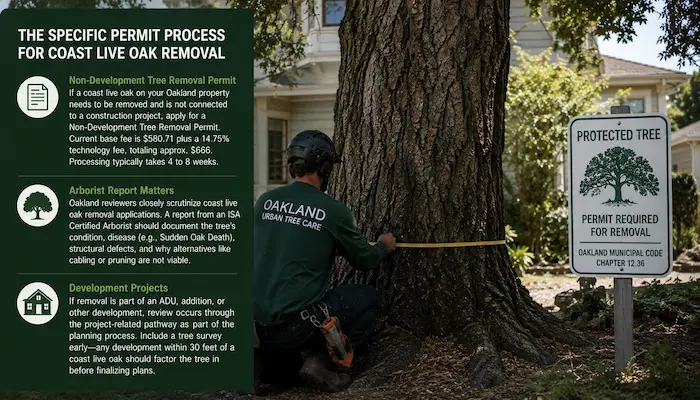
If a coast live oak on your Oakland property genuinely needs to be removed, the process runs through the city’s Non-Development Tree Removal Permit pathway when the removal is unconnected to any construction project. The current base fee is $580.71 plus a 14.75 percent technology fee, totaling approximately $666. Processing typically takes 4 to 8 weeks.
Given the strict protection status of coast live oak, Oakland’s reviewers scrutinize removal applications for this species more closely than for less-protected trees. A well-documented written report from an ISA Certified Arborist carries significant weight in this review. The report should document the tree’s specific condition, including whether Sudden Oak Death symptoms are present, whether structural defects exist, and whether less drastic alternatives such as structural cabling or targeted crown reduction pruning were considered and ruled out. Our tree health assessment service prepares these reports specifically for coast live oak applications, addressing the disease and structural factors that Oakland’s reviewers look for.
If your coast live oak removal is connected to an ADU, addition, or other development project, the review happens through the project-related pathway instead, with the tree assessment folded into the broader planning review. Given the strict protection threshold, any Oakland development project within 30 feet of a coast live oak of any meaningful size should include a tree survey early in the design process, before plans are finalized around an assumption that the tree will not be an obstacle.
Coast live oak’s biology creates a specific and serious vulnerability that does not apply to most other trees in Oakland’s urban forest. Sudden Oak Death, caused by the pathogen Phytophthora ramorum, has killed over a million oaks across coastal California since it was first identified, according to UC Statewide IPM Program research. Oakland sits within the coastal fog belt and oak woodland zone where this pathogen thrives.
Coast live oak is what researchers call a terminal host for Phytophthora ramorum, meaning the pathogen does not spread easily from oak to oak directly through bark contact. Instead, the pathogen primarily lives and reproduces on the leaves and twigs of California bay laurel, a very common companion species throughout Oakland’s hillside and wooded residential lots. Rain and wind carry spores from infected bay laurel foliage onto nearby oak bark, where the pathogen then enters through small wounds or natural openings and establishes a canker beneath the bark surface. According to UC IPM published research, increasing the physical distance between coast live oak and California bay laurel measurably reduces both the risk and severity of infection.
The clearest visible symptom of Sudden Oak Death infection in coast live oak is bleeding sap from a bark canker. This sap is thick and sticky, often described as smelling like the inside of a wine barrel, and ranges in color from deep burgundy to nearly black or amber orange. Recent rainfall can cause the sap to run further down the trunk, leaving visible staining on the bark below the canker site. A telling secondary indicator is dead moss or lichen on the bark immediately surrounding the canker, since the sap is toxic enough to kill these organisms on contact even before the larger infection becomes obvious. Importantly, only larger oaks, generally those above 4 inches DBH, the same threshold used in Oakland’s ordinance, typically show visible symptoms. Infections in young saplings are extremely rare.
If You See Bleeding Cankers on Your Coast Live Oak Bleeding cankers are not a problem to wait out. Schedule a professional assessment promptly. While Sudden Oak Death has no cure once established, certain phosphonate treatments applied preventatively or in early infection stages have been shown in published California Agriculture research to control the pathogen for up to two years. Catching infection early gives you genuine treatment options. Waiting until the canopy shows widespread dieback typically means the infection is too advanced for treatment to be effective, and removal becomes the only remaining option. |
Property owners with coast live oaks can take concrete steps to reduce Sudden Oak Death risk. Removing or maintaining significant distance between California bay laurel and coast live oak trees on the same property is the single most effective preventive measure, since bay laurel is the primary spore-producing host. Avoid pruning oaks during the wet season and during the spring through fall window when sap beetles that can carry the pathogen are most active. Never relocate or use firewood cut from infected host trees, since this can physically transport the pathogen to new locations. Sterilize pruning tools between cuts and between trees, particularly when working on multiple oaks on the same property.
Coast live oak requires more precise pruning timing than most other Oakland tree species, and getting this wrong has consequences beyond typical pruning mistakes.
Winter, specifically November through February, is the safest period to prune coast live oak in Oakland. During this period, the sap beetles that transmit Sudden Oak Death spores between infected and healthy trees are largely dormant, and fresh pruning wounds have the lowest risk of pathogen entry. Pruning between April and July carries the highest infection risk, since this period overlaps with both peak beetle activity and peak spore production on infected bay laurel host plants nearby. Our tree pruning service schedules all coast live oak structural work within this winter safe window whenever the work is not an emergency.
Removing more than 25 percent of a coast live oak’s live canopy in any 12 month period both triggers Oakland’s permit requirement and creates serious physiological stress for the tree itself. Oaks rely on their full canopy to produce the energy reserves needed for root system maintenance and disease resistance. Excessive pruning weakens a tree’s natural defenses precisely when Sudden Oak Death and other pathogens are most likely to take hold. This is one of the rare cases where the legal threshold and the biological safety threshold are the same number, reinforcing why the 25 percent rule should never be treated as a target to approach.
Any tool used to cut into a coast live oak should be sterilized with a 10 percent bleach solution or comparable disinfectant between trees, and ideally between major cuts on the same tree if any disease symptoms are suspected. This single practice meaningfully reduces the risk of transmitting Phytophthora ramorum or other wood-decay pathogens from an infected tree to a healthy one during the same work session.
Beyond disease, coast live oak’s growth habit creates specific structural risks that Oakland property owners should monitor.
Coast live oak naturally tends to develop multiple competing leader stems rather than a single dominant trunk, particularly when grown in open conditions without early structural training. This makes co-dominant stems with included bark, a leading cause of catastrophic limb failure during Oakland’s Diablo wind events, more common in this species than in many others. Young coast live oaks benefit significantly from structural pruning in their first 15 years to establish a single dominant leader and well-spaced scaffold branches, preventing this defect from developing in the first place.
Mature coast live oaks develop wide, spreading canopies that can extend well beyond what their trunk diameter suggests, with root systems extending an equivalent distance underground. This creates two practical considerations for Oakland homeowners: canopy proximity to structures often exceeds initial expectations as the tree matures, and root zone disturbance from nearby construction or hardscaping can affect the tree’s health and stability even when the work occurs well outside the visible drip line.
At Oakland Urban Tree Care, coast live oak care is one of our most frequently requested and most carefully handled services. Our ISA Certified Arborists understand both the legal requirements under Chapter 12.36 and the biological realities of Sudden Oak Death risk that make this species different from any other tree in Oakland’s urban forest. We provide tree health assessment with disease screening, properly timed tree pruning, structural cabling for trees with co-dominant stem defects, full permit management for removals, stump grinding, and native species replacement planting when removal is genuinely the right outcome. Our complete service range also includes tree removal, tree trimming, emergency tree service, storm damage cleanup, and lot clearing. Call us today for a coast live oak assessment from arborists who understand exactly what this species needs.
Call Oakland Urban Tree Care: +1 510 726 2544
Get a Free Coast Live Oak Assessment at OaklandUrbanTreeCare.com