
There is a question Oakland homeowners ask us more than almost any other: how close is too close for a tree to be to my house? It sounds like it should have a simple numerical answer. And while distance guidelines do exist, the more honest answer is that the threshold at which a tree becomes a problem for your home depends on the species, the tree’s size and structural condition, the type of foundation your Oakland home has, what is between the tree and the house underground, and how the Oakland microclimate affects both root growth and storm-related failure risk.
This guide gives you the specific distance guidelines, the warning signs that your tree has already crossed from tolerable proximity into active risk, the Oakland-specific legal provisions that govern trees close to structures, and the decision framework for choosing between management and removal. If you have a tree that you are already concerned about near your Oakland home, our ISA-certified arborists at Oakland Urban Tree Care provide free on-site assessments that give you a specific, property-based answer rather than a generalized guideline.
Arboricultural best practice and the published guidance of tree care professionals consistently converge on distance thresholds that depend primarily on the mature size of the tree species in question. These are the distances at which new planting should be avoided and at which existing trees warrant professional assessment for active risk management.
Tree Size Category | Minimum Safe Distance | Oakland Species Examples |
Small ornamental trees | 10 to 15 feet | Japanese maple, flowering plum, redbud |
Medium deciduous trees | 15 to 25 feet | Liquidambar, Chinese pistache, ornamental pear |
Large shade trees | 25 to 40 feet | Valley oak, coast live oak, California sycamore |
Very large or aggressive species | 40 to 50 feet plus | Blue gum eucalyptus, Monterey pine, Canary Island pine |
Trees with invasive root systems | Species-specific; consult arborist | Ficus, cottonwood, weeping willow |
These distances are planting guidelines for new trees. For existing Oakland trees that are already closer than these thresholds, the question is not simply whether to remove them but whether active management is controlling the specific risks they present. A coast live oak with a well-maintained crown and no visible root intrusion at 18 feet from a solid concrete foundation may be manageable with regular professional tree pruning. The same species at 15 feet with visible root heaving in the adjacent paving and a co-dominant stem leaning toward the roofline is a different risk profile entirely and warrants a serious removal conversation.
Oakland’s residential landscape presents a specific challenge: much of the city’s housing stock was built between 1900 and 1960, and many of the trees on these properties were planted long before mature-size spacing guidelines were widely applied. A Rockridge craftsman bungalow with a 70-year-old coast live oak growing 12 feet from the front wall is not an unusual situation. It is the norm in many Oakland neighborhoods. The appropriate response to that situation is not automatic removal but informed assessment of what the tree is actually doing to the structure and what management can and cannot address.
Proximity to a structure creates risks through two primary pathways: the root system underground and the canopy overhead. Both operate on timescales that Oakland homeowners frequently underestimate, which is why early assessment matters more than waiting for visible damage to appear.
Tree roots grow toward moisture and nutrient-rich soil. In Oakland’s residential environment, that means they grow toward irrigation water, drainage lines, and the disturbed, amended soil around building foundations. According to ISA root management research, tree roots typically extend two to three times the width of the canopy and can travel much further in compacted urban soils where they follow paths of least resistance along utility trenches, drainage channels, and the edges of hardscaping. A tree 20 feet from your Oakland home may have roots directly under your foundation slab or into your sewer lateral long before any surface evidence appears.
The specific risks of root proximity depend on your foundation type. Oakland’s older housing stock includes many homes with raised wood-frame foundations, where root intrusion into the crawl space and against pier footings is more immediately damaging than root contact with a modern continuous concrete slab. Pier-and-beam foundations in Oakland’s hillside craftsman homes are particularly vulnerable to root desiccation cracking, where tree roots draw moisture from the soil adjacent to foundation piers during dry season, causing the clay-heavy soils to shrink and the pier footings to settle unevenly.
Canopy proximity to a structure creates three distinct failure modes that Oakland’s storm patterns make more likely than in most California cities. Branch breakage during Diablo wind events, which produce sudden high-speed gusts with little warning, is the most acute risk for any branch extending over or adjacent to a roofline. Whole-tree lean failure during atmospheric river events, when weeks of rainfall saturate the root zone of hillside trees and reduce soil anchorage capacity, is the most catastrophic failure mode. And slow-load contact, where branches resting against or repeatedly contacting roof surfaces, gutters, or siding cause progressive damage through abrasion, moisture retention, and pest pathways, is the most insidious because it accumulates over years without any single dramatic incident. Oakland’s Hazardous Tree Ordinance, administered through the city’s hazardous tree process, exists specifically because the consequences of these canopy failures on neighboring properties create a legitimate public safety concern beyond the private property question.
Beyond structural damage, trees close to Oakland homes create secondary risk vectors that compound the direct physical damage risks. Branch contact with siding and roofing creates entry pathways for moisture that lead to rot, mold, and dry rot in wood-frame construction. Overhanging branches provide travel highways for squirrels, roof rats, and Formosan termites, all of which are actively present in Oakland’s urban environment, to access the structure without ground-level obstacles. Dense canopy coverage of a roof surface retains moisture after Oakland’s winter rains and fog, creating ideal conditions for moss growth, lichen colonization, and accelerated shingle degradation. Homeowners’ insurers in California are increasingly scrutinizing tree proximity during policy renewals, and several carriers have issued non-renewal notices to Oakland properties where trees are visibly overhanging the structure.
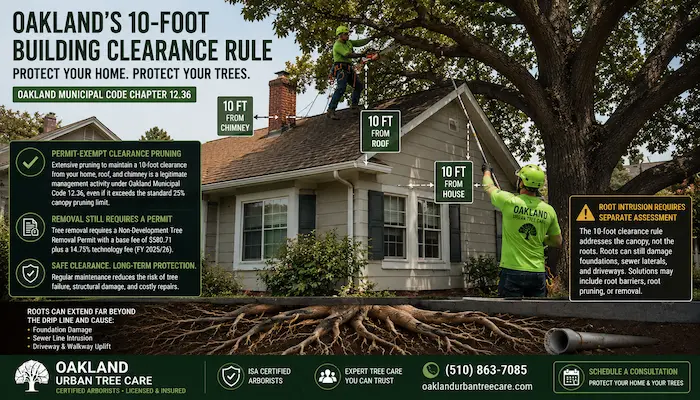
Oakland Municipal Code Chapter 12.36, the Protected Tree Ordinance, contains a specific provision that is directly relevant to trees close to structures and is frequently overlooked by homeowners and even some tree service companies. Under the ordinance, extensive pruning to maintain a 10-foot clearance in all directions from an existing building, including 10 feet above the roof and 10 feet from any chimney or stovepipe outlet, is specifically acknowledged as a legitimate management activity even when that pruning removes more than the standard 25 percent of the functioning canopy that would otherwise require a permit.
This provision exists precisely because the city recognizes that trees planted close to structures in Oakland’s dense residential neighborhoods require ongoing management that may exceed standard pruning thresholds. It is not a free pass to remove a protected tree without a permit. Removal still requires a Non-Development Tree Removal Permit with a base fee of $580.71 plus a 14.75 percent technology fee under the current FY 2025/26 fee schedule. But it does mean that aggressive crown management to maintain safe clearance from your home is a recognized, permit-exempt activity when performed by qualified professionals maintaining the defined clearance zone.
The 10-foot building clearance provision addresses the canopy. It does not address root system intrusion. A coast live oak with its canopy maintained at 10 feet from your Oakland home may still have a root system that extends under your foundation, into your sewer lateral, and beneath your driveway. Root proximity risks are not managed by canopy pruning. If root intrusion is the primary concern, a separate assessment of root zone extent and foundation contact is required, and the management options are root barriers, targeted root pruning, or removal depending on the extent and nature of the intrusion.
These observable signs indicate that a tree near your Oakland home has moved from proximity concern to active risk, and each warrants a professional assessment before the next storm season.
Oakland-Specific Warning: Hillside Properties and Root Zone Saturation On Oakland Hills and Montclair hillside properties, the wet season risk of tree-near-house damage is compounded by soil saturation dynamics that flatland properties do not experience to the same degree. When hillside soils become fully saturated during atmospheric river events, root plates lose anchorage capacity in ways that can cause trees to lean or uproot suddenly. A tree that has stood safely at 15 feet from a hillside structure for decades can become a genuine emergency after three weeks of sustained winter rain. Annual pre-storm season assessment of trees near structures on hillside Oakland properties is not optional. It is a basic property protection measure. |
The discovery that a tree is too close to your Oakland home does not automatically mean the tree needs to come down. The appropriate response depends on what the tree is specifically doing, what interventions are available, and whether those interventions can provide durable long-term risk reduction or only temporary mitigation.
Crown management through professional tree pruning and tree trimming is the appropriate response when the primary risk is canopy proximity rather than root intrusion, the tree is otherwise structurally sound with no advanced decay, the tree is a protected species under Chapter 12.36 that the city would be unlikely to approve for removal without a compelling health or structural justification, and the clearance management can be sustained without removing so much canopy that the tree becomes a biological hazard from over-pruning. In these situations, an annual or biennial pruning program that maintains defined clearance from the structure, combined with structural cabling for any co-dominant stems or defect points identified in the assessment, can manage the risk effectively without losing the tree.
Removal is the appropriate response when the tree’s root system has already caused or is imminently threatening to cause foundation damage, sewer lateral intrusion, or major structural damage, when the tree has advanced internal decay, a compromised root plate, or a structural defect that presents an irremediable fall hazard toward the structure, when the canopy proximity cannot be managed within safe pruning thresholds without effectively destroying the tree’s viability, or when the tree is dead. In these situations, continuing to manage rather than remove the tree transfers ongoing risk to the property and its occupants. Our ISA-certified arborists apply a structured decision framework based on ISA tree hazard evaluation standards to every assessment of a tree near a structure, giving you a defensible, professionally documented basis for whichever decision is appropriate for your specific tree.
If removal is the right decision for a protected species near your Oakland home, the Non-Development Tree Removal Permit process applies. The permit application is supported by a written arborist report documenting the specific risks the tree presents to the adjacent structure. Applications supported by well-documented structural hazard evidence consistently receive favorable review from Oakland’s Tree Services Division. The current base fee is $580.71 plus a 14.75 percent technology fee. Processing takes 4 to 8 weeks for standard applications. For trees presenting imminent hazards, the expedited hazardous tree process allows faster action with appropriate documentation. Our team manages the permit application as a standard component of every close-proximity removal job we handle in Oakland.
Tree removal adjacent to a structure is technically the most demanding category of residential tree removal work. Every section of the tree must be rigged and lowered rather than dropped, the crew works in a constrained space with structure on one side and often a fence, neighbor, or utility on other sides, and the root proximity to the foundation affects the post-removal stump grinding protocol. Our tree removal service handles close-structure removals as standard work, with site-specific protection plans, rigged lowering on every section, and structural surface protection applied before the first cut is made.
Before any cuts begin, professional structure-adjacent removals include rubber padding and foam protection on roof edges, gutters, and any projecting architectural features within the work zone, plywood or rubber mat protection on deck and patio surfaces beneath the rigging zone, specific rigging anchor placement that ensures each section descends in a direction away from the structure, and pre-removal documentation of existing surface condition so that any incidental contact during the job is immediately identifiable.
After removal of a large tree close to a house, the underground root system decomposes over the following two to five years. This decomposition process can cause minor ground settling and the formation of small voids in soils where large roots once provided support. On Oakland hillside properties, monitoring for soil movement near the foundation in the first two rainy seasons after a large-tree removal is a worthwhile precaution. Our stump grinding service removes the visible stump and surface root flare, and we discuss post-removal site monitoring recommendations as part of every close-structure job.
Most Oakland tree removal permits for close-proximity removals include a replanting condition. The replacement species selection is an important decision that Oakland homeowners frequently make without adequate information, which leads to the same close-proximity problem developing again in a new tree within 20 years. Our tree planting and urban tree care team advises on species selection that accounts for the correct planting distance from the structure, the mature size of the replacement species at the Oakland planting site conditions, the root behavior of candidate species relative to your foundation type, and the permit-specified replacement requirements. Getting this decision right prevents the same problem from recurring in the next generation of the property’s tree canopy.
At Oakland Urban Tree Care, our full range of close-structure tree services covers every stage of the process: tree health assessment, tree pruning, tree trimming, tree cabling, tree removal, emergency tree service, stump grinding, storm damage cleanup, and replacement tree planting. Call us today for a free on-site assessment of any tree you are concerned about near your Oakland home.
Call Oakland Urban Tree Care: +1 510 726 2544