Quick Answer Oakland Municipal Code Chapter 12.36 is the city’s Protected Tree Ordinance. It requires a permit before removing, relocating, or performing significant pruning work on any protected tree on private or public property in Oakland. Protection thresholds vary by species: coast live oaks, valley oaks, bay laurels, and buckeyes are protected at just 4 inches diameter at breast height (DBH), making Oakland’s oak protections the strictest in the Bay Area. Other native species are protected at 9 inches DBH. Eucalyptus globulus (blue gum) and Monterey pine are exempt from permit requirements. Permit fees start at $434.20 for a Non-Development permit. Violations can result in fines up to $1 million under Oakland’s civil penalty code. The ordinance applies to both private property trees and trees in the public right-of-way. |
Most Oakland homeowners first encounter Chapter 12.36 at exactly the wrong moment: a tree crew is already in the yard, a neighbor has complained, or code enforcement is at the door. The ordinance’s language is dense, its protections are species-specific and size-specific, and the consequences of getting it wrong, which include fines that can reach into six figures and legally required replanting at your expense, are serious enough to warrant understanding before you make any decisions about trees on your property.
This guide translates Oakland’s Protected Tree Ordinance into plain English for property owners, buyers, developers, and anyone else trying to understand what they can and cannot do with trees in Oakland without triggering a permit requirement or a code enforcement action. It covers the full scope of what is protected, what requires a permit, how permits work in practice, what the penalties look like, and when the ordinance does not apply.
Chapter 12.36 of the Oakland Municipal Code establishes a regulatory framework for the protection, removal, and replacement of trees throughout Oakland. The ordinance applies to trees on private property, trees in the public right-of-way, and trees subject to development-related impacts. Its purpose, stated in the ordinance itself, is to preserve and protect significant trees that contribute to Oakland’s urban forest, property values, air quality, stormwater management, wildlife habitat, and neighborhood character.
Oakland’s urban tree canopy is recognized as essential urban infrastructure. The city’s coast live oaks are among the most ecologically significant urban trees in California, many of them centuries old. The Sudden Oak Death epidemic that began spreading through the East Bay in the early 2000s has already permanently reduced the region’s oak population. Chapter 12.36 reflects Oakland’s policy that the loss of significant trees must go through a deliberate, regulated process with documented justification, not simply a decision made with a phone call and a chainsaw.
The full text of Chapter 12.36 is publicly available on Oakland’s Municode Municipal Code Library. The language is detailed and in places ambiguous, which is why working with an ISA Certified Arborist who knows Oakland’s specific interpretation and enforcement practices is strongly recommended before any significant tree work is planned.
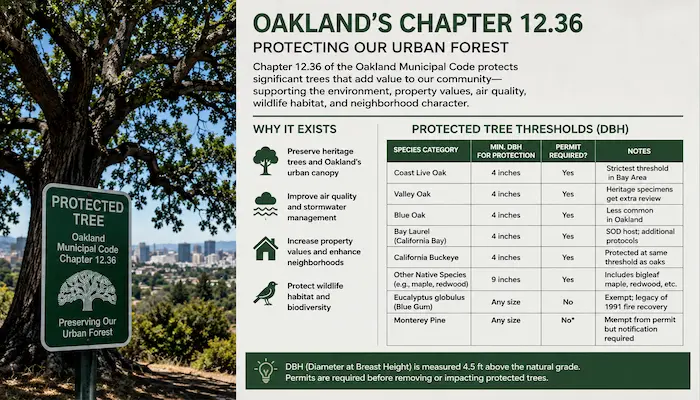
The ordinance protects trees based on a combination of species classification and trunk diameter. This is where most Oakland homeowners run into confusion, because the threshold sizes are much smaller than most people expect, particularly for oak species.
DBH is the standard arboricultural measurement of trunk diameter taken at 4.5 feet above the natural grade of the soil at the base of the tree. This is not the circumference of the trunk, which many people measure first and divide incorrectly. DBH is the diameter only. A tree trunk with a circumference of 12.6 inches has a DBH of approximately 4 inches. You can measure DBH directly with a diameter tape, or measure circumference with a standard tape and divide by pi (3.14). On sloped ground, DBH is measured from the uphill side of the trunk at 4.5 feet above the soil surface on that side. These same professional measurement standards are used by qualified arborists nationwide, including teams such as Tree Removal Columbia SC Pros, when evaluating tree size, safety risks, and removal requirements.
As of the most recent ordinance verification in 2026, Oakland’s protected tree thresholds are as follows:
Species Category | Min. DBH for Protection | Permit Required? | Notes |
Coast Live Oak | 4 inches | Yes | Strictest threshold in Bay Area |
Valley Oak | 4 inches | Yes | Heritage specimens get extra review |
Blue Oak | 4 inches | Yes | Less common in Oakland |
Bay Laurel (California Bay) | 4 inches | Yes | SOD host; additional protocols |
California Buckeye | 4 inches | Yes | Protected at same threshold as oaks |
Other Native Species | 9 inches | Yes | Includes bigleaf maple, redwood, etc. |
Eucalyptus globulus (Blue Gum) | Any size | No | Exempt; legacy of 1991 fire recovery |
Monterey Pine | Any size | No* | Exempt from permit but notification required |
Non-native species | Varies by context | Depends | Check with Planning Bureau |
Important Note on Monterey Pine Although Monterey pines are exempt from the standard permit requirement, Oakland Municipal Code Section 12.36.070 requires that the property owner or arborist notify the Office of Parks and Recreation in writing before removing any Monterey pine, stating the address, number, and size of trees to be removed. Public posting of the planned removal is also required. Skipping this notification step is a violation even though no formal permit is needed. |
A tree that meets the species and size thresholds above is protected, meaning any of the following activities require a permit before they can be performed: removal, relocation to another site, any pruning that removes more than 25 percent of the live canopy in a 12-month period, any grading or root-zone disturbance within the tree’s critical root zone, and any work that would materially affect the tree’s health or structural integrity. This is broader than most homeowners expect. It is not just about cutting a tree down.
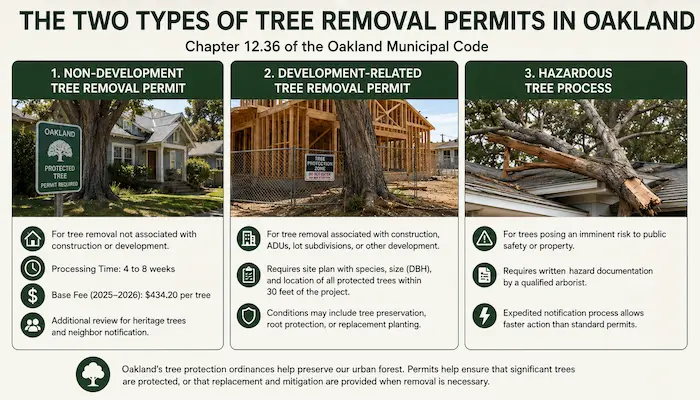
Chapter 12.36 establishes two distinct permit pathways, and which one applies to your situation determines both the process and the timeline. Choosing the wrong process or skipping the determination is one of the most common compliance errors Oakland property owners make.
A Non-Development permit applies when the tree removal is not associated with a construction project, development application, or building permit. This is the most common permit type for residential property owners removing a problematic, dead, diseased, or hazardous tree in their yard. The application is submitted to Oakland’s Bureau of Planning, Tree Services Division. Processing time for a standard application ranges from 4 to 8 weeks. The current base fee is $434.20 per tree as of the 2025 to 2026 fiscal year fee schedule. Additional notification and review steps apply for heritage trees and trees requiring neighbor notification.
When tree removal is associated with a construction project, an ADU application, a lot subdivision, or any other development activity requiring a building or planning permit, the tree review is handled as part of the development review process rather than as a standalone permit. Applicants must provide a site plan showing the location, species, and DBH of all protected trees within 30 feet of proposed development activity. The tree reviewer evaluates the development impact on protected trees, and conditions may be placed on the project requiring tree preservation measures, root zone protection during construction, or replacement planting.
Oakland also maintains a separate Hazardous Tree Ordinance that addresses trees posing an imminent risk to public safety or neighboring properties. If a tree has already failed, is actively threatening a structure, or has been assessed by a certified arborist as presenting an imminent and documentable hazard, there is an expedited notification process that allows faster action than the standard 4 to 8 week permit timeline. Crucially, the hazardous condition must be documented in writing by a qualified professional before the fast-track process is available. Our tree health assessment team prepares the written hazard documentation that Oakland’s process requires.
The permit application process intimidates many Oakland homeowners, but it is straightforward when you understand what is actually required. The steps below apply to the standard Non-Development permit for residential properties.
Step | What Is Required |
1. Identify the tree | Confirm species and measure DBH to determine if the tree is protected |
2. Pre-application conference | Optional but recommended for large or heritage trees; request through City Planning |
3. Prepare application documents | Site plan, tree location survey, species identification, reason for removal |
4. Written arborist report | Required for most applications; must document tree condition, hazard level if applicable |
5. Submit to Bureau of Planning | Online via Accela portal or in person at 250 Frank H. Ogawa Plaza |
6. Pay the application fee | $434.20 base fee per tree for FY 2025-2026 |
7. Neighbor notification | Required for trees visible from adjacent properties; posting period applies |
8. City review and decision | 4 to 8 weeks for standard applications; longer for heritage tree reviews |
9. Replacement requirement | Most approvals include a replanting condition; ratio varies by species and size |
Most Oakland tree removal permit applications require a written report from a qualified arborist documenting the tree’s current condition, the reason removal is justified, and whether any alternative to removal was considered. This report carries significant weight in the review process: a well-prepared arborist report that clearly documents a tree’s declining health, structural hazard, or disease status substantially improves the odds of approval. A vague or incomplete report leads to delays, additional information requests, and sometimes denial. Our ISA-certified arborists at Oakland Urban Tree Care prepare Chapter 12.36 compliance reports as a standard part of our permit assistance service.
Permit approval almost always comes with a replanting condition. Oakland typically requires that removed protected trees be replaced with new trees of a specified size, species, and number, planted either on the same property or in an approved off-site location. Replacement ratios vary depending on the species and canopy size of the removed tree, but a common starting point is one for one replacement with a 15-gallon or 24-inch box container tree. For large heritage specimens, replacement requirements can be more substantial. Our tree planting and urban tree care team handles all replacement planting as part of our permit completion service, ensuring the replanting conditions are satisfied correctly and documented for the city file.
This is where the consequences of ignoring Chapter 12.36 become very real. Oakland’s enforcement of the Protected Tree Ordinance has become significantly more active in recent years, driven in part by several high-profile violations in hillside neighborhoods and increased complaints from residents.
Oakland Municipal Code Chapter 1.08 establishes the civil penalty framework that applies to tree ordinance violations. Penalties for unpermitted removal of a protected tree can reach up to $1,000 per day per violation, and in egregious cases involving large or heritage specimens, enforcement actions have resulted in total penalties in the hundreds of thousands of dollars. The May 2026 case on Claremont Avenue, in which a property owner was cited for removing 38 protected trees without permits, resulted in fines approaching one million dollars and a mandatory replanting program. That case was widely reported in the East Bay press and fundamentally changed how many Oakland homeowners think about tree work.
Beyond fines, unpermitted removal triggers a mandatory replanting requirement. The city can require you to plant replacement trees at a ratio determined by the Tree Reviewer, and the species, size, and placement of those replacements may be specified by the city rather than chosen by the property owner. Replacement of a mature heritage oak at the ratios applied to large specimens can cost thousands of dollars in tree stock and installation costs alone, separate from any fines.
Unresolved tree ordinance violations become encumbrances on the property title. If you have unpermitted removals on record when you attempt to pull a building permit for a renovation, addition, or ADU, the Planning Bureau will typically require resolution of the tree violation before issuing the building permit. In real estate transactions, title searches that reveal outstanding tree enforcement actions can complicate or delay closings. Buyers have successfully used undisclosed tree violations as grounds for renegotiating purchase price or demanding seller remediation.
If you purchase a property and later discover that a previous owner removed protected trees without permits, you may still be responsible for the replanting obligation as the current property owner. Contact Oakland’s Bureau of Planning, Tree Services Division proactively to disclose the situation and negotiate a resolution before enforcement action is initiated. Voluntary disclosure typically results in more favorable treatment than a response to a formal enforcement notice. Our Oakland Urban Tree Care team has assisted multiple property owners in navigating legacy compliance situations with the city.
Many Oakland property owners are surprised to learn that even pruning a protected tree can trigger a permit requirement. Removing more than 25 percent of a protected tree’s live canopy in any 12-month period requires a permit under Section 12.36. This is one of the most frequently overlooked provisions of the ordinance. Standard tree trimming and tree pruning performed by professional arborists within the 25 percent threshold does not require a permit, but work exceeding that threshold on a protected species does. Our crews track canopy removal percentage on every job involving protected trees.
Trees confirmed positive for Sudden Oak Death caused by the pathogen Phytophthora ramorum present a special situation under Chapter 12.36. Oakland’s enforcement of replacement requirements has historically been more flexible for confirmed SOD-positive trees than for healthy trees removed for convenience. However, the removal still requires a permit, and the SOD-positive status must be confirmed by a qualified professional. A tree health assessment that includes laboratory confirmation of SOD infection is the appropriate precursor to a permit application for an affected oak. The International Society of Arboriculture maintains a directory of certified arborists qualified to perform disease assessments.
One of the most commonly overlooked aspects of Chapter 12.36 is its application to construction activity near protected trees, not just removal. Grading, trenching, footing excavation, or any activity that disturbs soil within the critical root zone of a protected tree requires a permit and typically requires tree protection measures to be specified in a plan. If you are planning an ADU, a home addition, a driveway expansion, or any hardscaping within 15 to 20 feet of a protected tree, consult with an ISA Certified Arborist before submitting any permits. Construction that unknowingly damages the critical root zone of a protected tree can result in the same penalties as unpermitted removal if the damage results in tree death.
Chapter 12.36 applies equally to trees in the public right-of-way adjacent to private property. Street trees in Oakland are city assets regardless of where they are planted. Property owners may not remove, prune above the 25 percent threshold, or place structures within the root zones of street trees without a permit. Complaints about street trees that are hazardous or interfering with property can be directed to Oakland’s Bureau of Public Works, which has its own review process separate from the private property permit pathway.
Navigating Chapter 12.36 without professional support is technically possible but practically difficult. The species identification questions alone, particularly for less-common native species, require arboricultural training. DBH measurement protocols on sloped ground are non-obvious. And the arborist report requirement means that the city’s review outcome is substantially shaped by the quality of the professional documentation submitted. At Oakland Urban Tree Care, we provide end-to-end Chapter 12.36 compliance support.
If you have trees on your Oakland property that you are uncertain about, the safest first step is always a professional tree health assessment from an ISA-certified arborist who knows Oakland’s specific ordinance thresholds and enforcement practices. We will tell you clearly what is protected, what requires a permit, what the likely approval timeline looks like, and what the most practical path forward is for your property.
Call Oakland Urban Tree Care: +1 510 863 7085
Get Expert Chapter 12.36 Guidance at OaklandUrbanTreeCare.com
