Quick Answer Large tree removal in Oakland, defined here as trees 60 feet or taller, requires more planning, more specialized equipment, and more regulatory awareness than most homeowners anticipate. Costs for large trees typically run between $1,500 and $5,000 depending on species, trunk diameter, access conditions, and proximity to structures. Many large Oakland trees are protected under Municipal Code Chapter 12.36 and require a permit before removal. Crane-assisted removal is often necessary for large trees on hillside properties or in tight urban lots. The entire process, from permit application to final stump treatment, typically takes 6 to 12 weeks from start to finish when done correctly and legally. |
Large trees are a defining feature of Oakland’s residential landscape. A mature valley oak stretching 90 feet above a Rockridge backyard. A century-old blue gum eucalyptus towering over an Oakland Hills property. A 75-foot Monterey pine shading an entire side of a Grand Lake home. These trees provide real value: shade, habitat, carbon storage, and a sense of permanence that no landscaping can replicate quickly. But when they need to come down, they are not small-tree problems at a bigger scale. They are fundamentally different projects requiring professional planning, specialized equipment, regulatory compliance, and considerably larger budgets.
This guide covers everything Oakland homeowners need to know about large tree removal: what makes these jobs categorically different from standard tree work, how Oakland’s permit requirements apply, what equipment is involved and why, what the full cost picture looks like, and how to protect your property through the entire process. If you have a large tree situation that needs professional eyes on it, our ISA-certified arborists at Oakland Urban Tree Care provide free on-site assessments and handle every step from permit to final site cleanup.
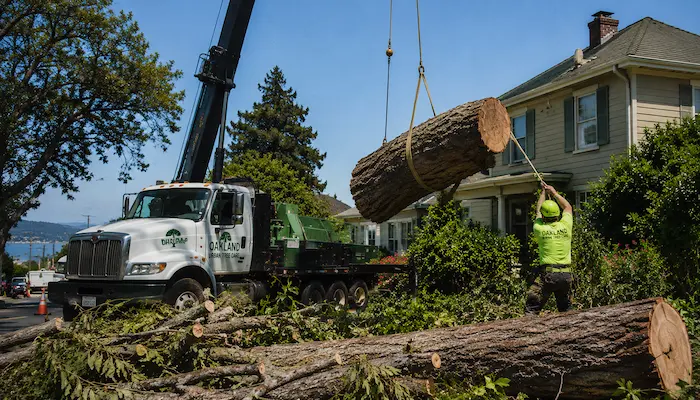
Many homeowners underestimate large tree removal because they have seen smaller trees taken down without incident. They assume the process scales proportionally. It does not. The complexity, risk, and cost of a large tree removal project increase at a rate that is well beyond linear as size increases, and Oakland’s specific site conditions add layers that do not exist in most other markets.
A 30-foot ornamental tree might weigh 500 to 1,000 pounds including its root ball. A mature 80-foot blue gum eucalyptus can weigh 20,000 to 40,000 pounds or more. Every section of that wood that comes down must be controlled with precision, because at those weights, an uncontrolled drop destroys whatever is in the fall zone. According to ISA rigging and removal standards, proper rigging and lift planning are among the most critical safety factors in complex tree removal operations. A crew working on a large tree must calculate tension loads on rigging lines, identify the distribution of weight in each section before it is cut, and account for the unpredictable behavior of internal decay or rot that may not be visible from outside the trunk.
Oakland has an unusually high concentration of very large trees concentrated in specific areas that create challenging removal conditions. The Oakland Hills and Montclair neighborhoods are dominated by mature blue gum eucalyptus, Monterey pine, and valley oak trees, many of them growing on steep slopes with limited equipment access and overhanging occupied structures. The flatlands around Grand Lake, Temescal, and Rockridge contain mature street-side and yard trees that have grown into the urban fabric, their canopies intertwined with power lines and their roots lifting adjacent hardscaping.
Today’s Homeowner noted in their 2026 Oakland market analysis that Oakland properties have an average tree height of 62 feet, significantly higher than most comparable California cities. This is not coincidence. It reflects both the age of Oakland’s housing stock and the presence of fast-growing eucalyptus and pine species that were widely planted in the mid-twentieth century and are now reaching their full mature scale.
Understanding the specific species on your property is the first step in any large-tree removal assessment. Different species present different challenges, and some have regulatory implications that others do not.
Eucalyptus globulus, the dominant large-tree species in the Oakland Hills and throughout East Bay neighborhoods, is the species most frequently removed in Oakland’s large-tree category. Blue gum eucalyptus is exempt from Oakland’s Chapter 12.36 permit requirement, which simplifies the regulatory side of removal significantly. However, the physical removal presents substantial challenges. Mature blue gums produce enormous volumes of debris: stringy fibrous bark, large limbs prone to sudden unexpected shedding, and heavy trunk sections that require careful crane planning on hillside properties. Their root systems can extend far beyond the drip line, and on steep slopes, removal of a large anchor tree can alter the stability of adjacent soil.
Monterey pines are a common large-tree removal request across Oakland, particularly in the Oakland Hills and Montclair. They grow rapidly and frequently reach 80 to 100 feet on Oakland properties. Although Monterey pine does not require a formal removal permit under Chapter 12.36, written notification to Oakland’s Office of Parks and Recreation is required before any removal. Monterey pines aged beyond 50 to 60 years in Oakland’s climate frequently develop structural issues including blue stain fungus, pine pitch canker disease, and bark beetle infestations. Dead or severely declining Monterey pines are particularly hazardous to remove because their wood becomes brittle and unpredictable, often requiring crane-assisted removal even on properties where a healthy tree might be handled with rope rigging.
Oakland’s native oaks are among the most structurally complex large-tree removals because of their spreading canopy architecture and, in many cases, their protected status under Chapter 12.36. Valley oaks can reach 60 to 100 feet with canopy spreads of 50 to 70 feet on well-established Oakland properties. Coast live oaks are typically shorter but often grow in dense clusters where removal of one requires careful rigging to protect adjacent trees and root systems. Both species require a Non-Development Tree Removal Permit, with the application process supported by a written arborist report from an ISA Certified Arborist. Our tree health assessment team prepares these reports as a standard component of our permit assistance service.
Monterey cypress, Canary Island pine, and large ornamental species including deodor cedar and atlas cedar are increasingly common in Oakland’s removal work. These species typically reach 60 to 80 feet in urban Oakland settings. They are generally not subject to species-specific protections under Chapter 12.36 unless they exceed the 9-inch DBH threshold for other native species or meet heritage tree criteria. However, their physical removal complexity on hillside or structure-adjacent properties is comparable to any other large species.
Large trees are disproportionately likely to be protected under Oakland’s Municipal Code Chapter 12.36, simply because protected thresholds are met more easily as trees grow. A coast live oak with a trunk circumference of 13 inches, roughly the diameter of a medium dinner plate, is protected and requires a permit. Most large oaks on Oakland properties have trunks many times that size and are deeply protected. Before any large tree removal project is planned, species identification and diameter measurement are required to determine whether a permit is needed.
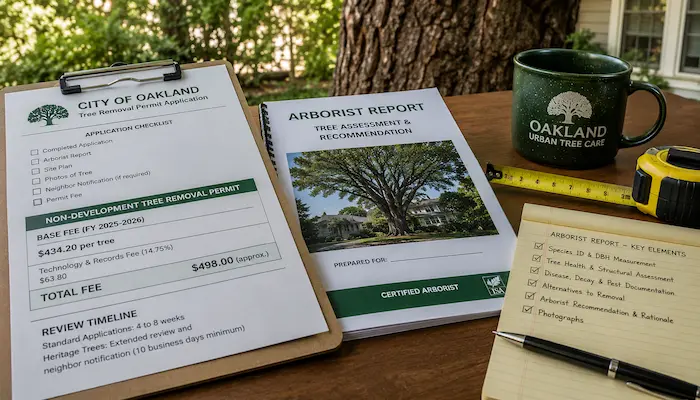
For large trees not associated with construction activity, the Non-Development Tree Removal Permit is the appropriate pathway. The base fee is $434.20 per tree for FY 2025 to 2026, with an additional technology and records fee of approximately 14.75 percent bringing the total to roughly $497 per tree. Review timelines for standard applications run 4 to 8 weeks. Heritage trees, defined by size and species significance, may involve extended review timelines and neighbor notification periods of at least 10 business days. Budget for the permit fee and timeline when planning a large tree removal and do not schedule crew mobilization until written approval is in hand.
Oakland’s permit process requires a written arborist report supporting the removal application. For large trees, this report carries more weight than for smaller specimens because the public benefit of retaining a large tree is greater and the city’s reviewers look more carefully at the justification. A complete arborist report for a large tree removal application covers: species identification and DBH measurement, assessment of the tree’s overall health and structural integrity, documentation of any disease, decay, or pest infestation, evaluation of whether alternatives to removal exist (cabling, pruning, root management), the arborist’s professional recommendation and the reasoning behind it, and photographs documenting the tree’s current condition. Our arborists prepare these reports to a standard that consistently supports permit approval in Oakland’s review process.
Understanding the specific species on your property is the first step in any large-tree removal assessment. Different species present different challenges, and some have regulatory implications that others do not.
Eucalyptus globulus, the dominant large-tree species in the Oakland Hills and throughout East Bay neighborhoods, is the species most frequently removed in Oakland’s large-tree category. Blue gum eucalyptus is exempt from Oakland’s Chapter 12.36 permit requirement, which simplifies the regulatory side of removal significantly. However, the physical removal presents substantial challenges. Mature blue gums produce enormous volumes of debris: stringy fibrous bark, large limbs prone to sudden unexpected shedding, and heavy trunk sections that require careful crane planning on hillside properties. Their root systems can extend far beyond the drip line, and on steep slopes, removal of a large anchor tree can alter the stability of adjacent soil.
Monterey pines are a common large-tree removal request across Oakland, particularly in the Oakland Hills and Montclair. They grow rapidly and frequently reach 80 to 100 feet on Oakland properties. Although Monterey pine does not require a formal removal permit under Chapter 12.36, written notification to Oakland’s Office of Parks and Recreation is required before any removal. Monterey pines aged beyond 50 to 60 years in Oakland’s climate frequently develop structural issues including blue stain fungus, pine pitch canker disease, and bark beetle infestations. Dead or severely declining Monterey pines are particularly hazardous to remove because their wood becomes brittle and unpredictable, often requiring crane-assisted removal even on properties where a healthy tree might be handled with rope rigging.
Oakland’s native oaks are among the most structurally complex large-tree removals because of their spreading canopy architecture and, in many cases, their protected status under Chapter 12.36. Valley oaks can reach 60 to 100 feet with canopy spreads of 50 to 70 feet on well-established Oakland properties. Coast live oaks are typically shorter but often grow in dense clusters where removal of one requires careful rigging to protect adjacent trees and root systems. Both species require a Non-Development Tree Removal Permit, with the application process supported by a written arborist report from an ISA Certified Arborist. Our tree health assessment team prepares these reports as a standard component of our permit assistance service.
Monterey cypress, Canary Island pine, and large ornamental species including deodor cedar and atlas cedar are increasingly common in Oakland’s removal work. These species typically reach 60 to 80 feet in urban Oakland settings. They are generally not subject to species-specific protections under Chapter 12.36 unless they exceed the 9-inch DBH threshold for other native species or meet heritage tree criteria. However, their physical removal complexity on hillside or structure-adjacent properties is comparable to any other large species.
Large trees are disproportionately likely to be protected under Oakland’s Municipal Code Chapter 12.36, simply because protected thresholds are met more easily as trees grow. A coast live oak with a trunk circumference of 13 inches, roughly the diameter of a medium dinner plate, is protected and requires a permit. Most large oaks on Oakland properties have trunks many times that size and are deeply protected. Before any large tree removal project is planned, species identification and diameter measurement are required to determine whether a permit is needed.
For large trees not associated with construction activity, the Non-Development Tree Removal Permit is the appropriate pathway. The base fee is $434.20 per tree for FY 2025 to 2026, with an additional technology and records fee of approximately 14.75 percent bringing the total to roughly $497 per tree. Review timelines for standard applications run 4 to 8 weeks. Heritage trees, defined by size and species significance, may involve extended review timelines and neighbor notification periods of at least 10 business days. Budget for the permit fee and timeline when planning a large tree removal and do not schedule crew mobilization until written approval is in hand.
Oakland’s permit process requires a written arborist report supporting the removal application. For large trees, this report carries more weight than for smaller specimens because the public benefit of retaining a large tree is greater and the city’s reviewers look more carefully at the justification. A complete arborist report for a large tree removal application covers: species identification and DBH measurement, assessment of the tree’s overall health and structural integrity, documentation of any disease, decay, or pest infestation, evaluation of whether alternatives to removal exist (cabling, pruning, root management), the arborist’s professional recommendation and the reasoning behind it, and photographs documenting the tree’s current condition. Our arborists prepare these reports to a standard that consistently supports permit approval in Oakland’s review process.
The method used to remove a large tree in Oakland depends on three primary factors: the tree’s size and structural condition, the available access for equipment, and what is in the fall zone. Understanding the methods helps homeowners evaluate contractor proposals and set realistic expectations for what the job will look like on their property.
For large trees where equipment access exists but crane use is not required, sectional removal with rope rigging is the standard professional method. An ISA-certified climber ascends the tree and systematically removes sections from the crown downward, each section rigged on a lowering line controlled by a crew member on the ground. The rigging system controls the speed and direction of each piece as it descends, preventing it from contacting the structure, adjacent trees, or ground personnel below. This method requires trained climbers who understand rigging load calculations, block and tackle systems, and the behavior of wood under tension and compression. For a large tree it may involve a full crew of five to six people working for a full day or longer.
Crane-assisted removal is required or strongly recommended when a large tree is in a location where rope rigging alone cannot safely manage the weight and size of individual sections, where the tree is structurally compromised to the point that climbing is unsafe, or where the need to move large sections over structures or obstacles makes direct lowering impractical. A hydraulic crane of appropriate capacity is positioned as close to the tree as access allows. A certified rigging specialist works with the climber to attach each section before cutting, and the crane lifts the freed section clear of the fall zone before the crew on the ground processes it.
Crane rental and operation adds $500 to $2,500 or more per day to the project cost, depending on the lift capacity required and the operational hours. On Oakland Hills properties with steep driveways and limited street access, positioning a crane may require additional coordination with the city and neighboring properties. For very large eucalyptus or pine removals in these settings, crane use is not optional: it is the only method that meets the safety standards that ISA rigging guidelines specify for work of this complexity.
On Oakland properties where the tree is adjacent to a street or accessible area where a bucket truck can be positioned, aerial work platforms can significantly reduce the need for climbing and simplify the rigging of upper-crown sections. Bucket trucks are most practical for large trees on relatively flat properties in Oakland’s flatland neighborhoods, where street access is straightforward. On steep hillside properties, bucket truck access is often impractical, and crane or rope-rigging methods are required.
The volume of debris generated by a large tree removal is substantial and is itself a logistical consideration. A large eucalyptus or valley oak produces several truckloads of chipped material, heavy log sections, and fibrous bark debris. A professional removal team brings a wood chipper for branch material and a log loader for trunk sections. Site cleanup should be explicitly included in your written quote. Confirm what is included: chipping of all branch material, removal of log sections, raking of bark and debris, and any soil restoration at the stump site. Our stump grinding service is coordinated with every large tree removal job to complete the site in a single mobilization.
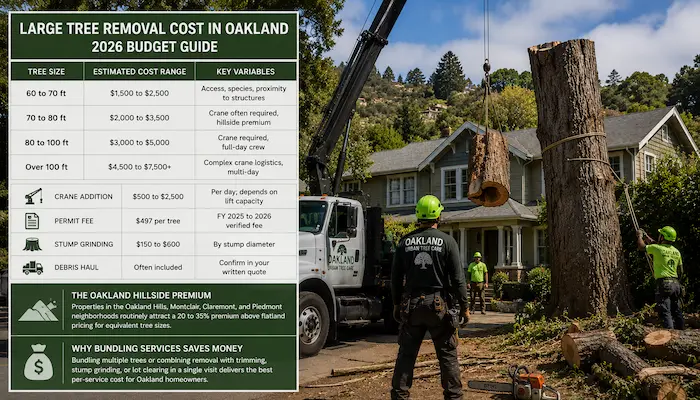
Oakland consistently prices at the upper end of California tree removal market rates, reflecting the East Bay’s higher labor costs, the logistical complexity of hillside properties, and the permitting overhead that legitimate companies include in their service. HomeAdvisor’s Alameda County data for 2025 to 2026 shows a typical range of $609 to $1,755 for general tree removal, with an Oakland market average of $1,142. That average, however, is heavily influenced by smaller trees. Large tree removals in Oakland regularly exceed these figures significantly.
Tree Size | Estimated Cost Range | Key Variables |
60 to 70 ft | $1,500 to $2,500 | Access, species, proximity to structures |
70 to 80 ft | $2,000 to $3,500 | Crane often required, hillside premium |
80 to 100 ft | $3,000 to $5,000 | Crane required, full-day crew |
Over 100 ft | $4,500 to $7,500+ | Complex crane logistics, multi-day |
Crane addition | $500 to $2,500 | Per day; depends on lift capacity |
Permit fee | $497 per tree | FY 2025 to 2026 verified fee |
Stump grinding | $150 to $600 | By stump diameter |
Debris haul | Often included | Confirm in your written quote |
Properties in the Oakland Hills, Montclair, Claremont, and Piedmont neighborhoods routinely attract a 20 to 35 percent premium above flatland pricing for equivalent tree sizes. The premium reflects real costs: crane access challenges on narrow hillside roads, the need for additional crew members to manage debris on steep slopes, extended setup times for safe rigging in constrained spaces, and sometimes the need for neighboring property access coordination. Budget for this premium from the outset if your property is in an elevated Oakland neighborhood.
If you have multiple trees to assess or remove, significant savings are available by bundling services. Mobilizing a crane, crew, and chipper for one large tree is expensive. Adding a second large tree on the same job day adds relatively little incremental cost because the fixed mobilization cost is already absorbed. Similarly, combining large tree removal with adjacent tree trimming, stump grinding, or lot clearing work in a single visit consistently produces the best per-service cost for Oakland homeowners.
Large tree removal is a controlled operation, but controlling it correctly requires specific protective measures that homeowners should expect their contractor to provide without being asked. Understanding what protection is appropriate helps you evaluate contractor quality before work begins.
After a large tree is removed, the root zone undergoes a gradual decay process as the underground root system decomposes. This process takes years and can create ground settling, minor sinkholes, and root channel voids beneath hardscaping. For properties where new construction or hardscaping is planned near the former root zone, allow for soil monitoring and compaction testing before building. For properties in fire risk zones, removal of a large anchor tree may also create wind exposure changes that affect adjacent vegetation and require reassessment of the surrounding landscape.
Not every large tree that worries an Oakland homeowner actually needs to come down. The most common reason homeowners contact us about large trees is concern about safety, and in a significant number of cases a thorough tree health assessment reveals that the tree is structurally sound and that the safety concern can be addressed with more targeted interventions.
An honest assessment from a qualified arborist will tell you what the tree actually needs, not what generates the largest invoice. At Oakland Urban Tree Care, we recommend removal only when it is genuinely the right answer for the tree’s condition, your property’s safety, and Oakland’s regulatory requirements. For trees that can be managed rather than removed, we provide the full range of structural care services that make retention both safe and sustainable.
Action | Why It Matters |
Identify species and measure DBH | Determines permit requirement under Chapter 12.36 |
Schedule ISA Certified Arborist assessment | Produces written report needed for permit; documents pre-removal condition |
Submit Non-Development permit application | Must be approved before work begins; allow 4 to 8 weeks |
Get three written, itemized quotes | Compare scope not just price; confirm crane, stump, debris are addressed |
Verify C49 license at cslb.ca.gov | Confirms contractor is legally authorized to perform removal work |
Request insurance certificates | Liability and workers’ comp certificates protect you from injury claims |
Notify PG&E if lines are near tree | Required before any work near overhead electrical infrastructure |
Plan replacement planting | Most permit approvals include replanting conditions; budget for this step |
Schedule stump grinding in same visit | Most cost-effective when done with the same crew mobilization |
At Oakland Urban Tree Care, we manage every item on this checklist for our clients. Our fully licensed, ISA-certified team handles the arborist assessment, permit application, large-tree removal with appropriate equipment for your specific site, stump grinding, replacement planting, and complete site cleanup in a coordinated service from first call to final inspection. Call us today for a free on-site estimate. We serve all Oakland neighborhoods including the Hills, Montclair, Rockridge, Temescal, Grand Lake, Fruitvale, and the broader East Bay.
Call Oakland Urban Tree Care: +1 510 863 7085
Get a Free Large Tree Removal Estimate at OaklandUrbanTreeCare.com
