
If you search for tree removal permit Oakland, you will find a confusing mix of terms: tree removal permit, protected tree permit, hazardous tree permit, and Non-Development Tree Removal Permit. For most Oakland homeowners trying to remove a single problematic tree from their own property without any construction project attached, the Non-Development Tree Removal Permit is the specific permit that applies. Understanding exactly what it is, when it is required, what it costs, and how the application process actually works is the difference between a smooth four to eight week process and a costly enforcement action.
This guide explains the Non-Development Tree Removal Permit in plain language: what makes it different from other Oakland tree permits, which trees actually require it, the complete application process and cost breakdown, and what happens if you skip it. If you have a tree on your Oakland property that you believe needs to come down, our ISA-certified arborists at Oakland Urban Tree Care handle the entire permit process as a standard part of every removal we perform.
The term non-development is doing important legal work in this permit’s name. Oakland’s Bureau of Planning distinguishes between two fundamentally different categories of tree removal based on what is driving the removal request, and each category has its own application pathway, its own review process, and in some cases its own fee structure.
A Non-Development Tree Removal Permit applies when a property owner wants to remove a protected tree for reasons unrelated to any building, grading, demolition, or land use permit. The most common reasons include a tree that is dead, diseased, or declining, a tree causing root damage to a foundation, driveway, or sewer line, a tree the owner simply no longer wants on the property, or a tree presenting a safety concern unrelated to any construction activity. The official City of Oakland application form requires the applicant to certify under penalty of perjury that no zoning, land use, grading, demolition, building, or other city permits have been applied for as a result of or in connection with the proposed tree removal. This certification is what defines the application as non-development.
When tree removal is connected to an approved or pending construction project such as an ADU, a home addition, a new driveway, or any activity requiring a building or planning permit, the tree review is handled through Oakland’s Project-Related Tree Removal Permit process instead. This pathway folds the tree review into the broader development review, requiring a site plan showing all protected trees within the construction footprint and often resulting in conditions tied to the overall project approval rather than a standalone tree permit fee.
Choosing the correct pathway is not optional or interchangeable. If your tree removal is genuinely unconnected to any development activity, you file a Non-Development application with its own standalone fee and timeline. If you misrepresent a development-related removal as non-development to access a potentially faster standalone process, the perjury certification on the application form creates direct legal exposure. If you are uncertain which category applies to your situation, particularly if you have any pending building permits or planning applications on the same property, consult with the Tree Services Division before submitting either application.
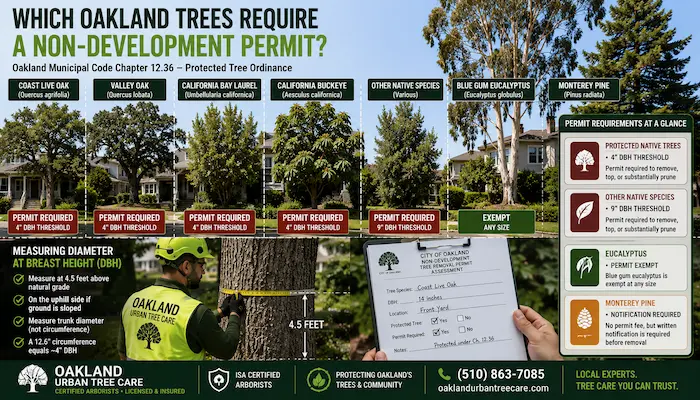
The Non-Development Tree Removal Permit requirement is governed by Oakland Municipal Code Chapter 12.36, the Protected Tree Ordinance, which protects trees based on a combination of species and trunk diameter at breast height, measured at 4.5 feet above natural grade.
Species Category | DBH Threshold | Permit Status |
Coast live oak | 4 inches | Permit required |
Valley oak | 4 inches | Permit required |
California bay laurel | 4 inches | Permit required |
California buckeye | 4 inches | Permit required |
Other native species | 9 inches | Permit required |
Blue gum eucalyptus | Any size | Exempt |
Monterey pine | Any size | Exempt, notification required |
Blue gum eucalyptus is fully exempt from the Non-Development permit requirement regardless of trunk size. This reflects Oakland’s post-1991 firestorm policy treating eucalyptus as a fire fuel management priority rather than a protected specimen. Monterey pine is similarly exempt from the formal permit process, but the city still requires written notification before removal. Any property owner or arborist intending to remove one or more Monterey pine trees must notify the Office of Parks and Recreation in writing, addressed to the Tree Reviewer at Park Services Division, 7101 Edgewater Drive, Oakland, CA 94621, stating the address, number, and size of the trees to be removed. Skipping this notification step is a violation even though no permit fee applies.
DBH is measured at 4.5 feet above the natural grade at the base of the tree, on the uphill side if the ground is sloped. This is the trunk’s diameter, not its circumference. A trunk with a 12.6 inch circumference has a DBH of approximately 4 inches, which is the exact threshold for Oakland’s most strictly protected native species. If you are unsure whether your tree meets the threshold, request a professional measurement before assuming either way.
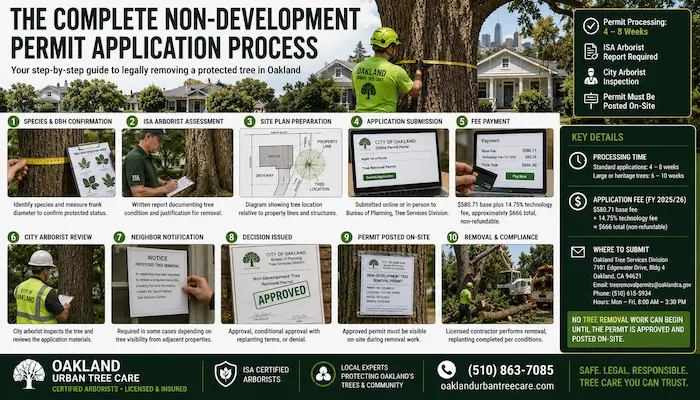
Step | What Happens |
1. Species and DBH confirmation | Identify species and measure trunk diameter to confirm protected status |
2. ISA arborist assessment | Written report documenting tree condition and justification for removal |
3. Site plan preparation | Diagram showing tree location relative to property lines and structures |
4. Application submission | Submitted online or in person to Bureau of Planning, Tree Services Division |
5. Fee payment | $580.71 base plus 14.75% technology fee, approximately $666 total, non-refundable |
6. City arborist review | City arborist inspects the tree and reviews the application materials |
7. Neighbor notification | Required in some cases depending on tree visibility from adjacent properties |
8. Decision issued | Approval, conditional approval with replanting terms, or denial |
9. Permit posted on-site | Approved permit must be visible on-site during removal work |
10. Removal and compliance | Licensed contractor performs removal; replanting completed per conditions |
Almost every Non-Development application requires a written assessment report from a qualified arborist documenting the tree’s species, size, current health and structural condition, the specific justification for removal, and whether alternatives to removal were considered. This report is not a formality. It is the primary evidence the city’s reviewer uses to evaluate the application, and a well-documented report substantially improves the odds of timely approval. According to ISA tree hazard evaluation standards, a thorough hazard or condition assessment should document specific, observable evidence rather than general impressions. Budget approximately $300 to $600 for this report if obtained independently, or request it as part of a full-service application package from a qualified arborist team.
Applications are processed through Oakland’s Tree Division, located at 7101 Edgewater Drive, Building 4, Oakland, CA 94621. The Tree Services Division can be reached at 510-615-5934 or by email at treeremovalpermits@oaklandca.gov for questions about the online permit process. Business hours are Monday through Friday, 8:00 AM to 3:30 PM. Most applications today are submitted through Oakland’s online permit portal, though in-person submission remains available by appointment.
Standard Non-Development applications typically process in 4 to 8 weeks. Applications involving large protected specimens or heritage trees can take 6 to 10 weeks due to additional review scrutiny. No removal work can legally begin until the permit is approved and the physical permit document is available to post on-site during the work, as required by the application’s terms.
The $580.71 base fee plus 14.75 percent technology and records fee, totaling approximately $666 per tree, is a flat administrative fee that applies regardless of the tree’s size, species, or the complexity of the removal itself. It covers the cost of the city arborist’s review and site inspection, application processing and record keeping, and the technology infrastructure that supports Oakland’s permit tracking system. The fee is non-refundable whether the application is approved, conditionally approved, or denied, and it is charged per tree, meaning a property with multiple protected trees requiring removal will incur this fee multiple times.
Multi-Tree Math: Why This Fee Adds Up Fast A residential lot with six protected coast live oaks requiring removal incurs approximately $4,000 in Non-Development permit fees alone, before any arborist report fees or actual removal costs. For multi-tree projects, confirm which trees are genuinely protected and which are exempt species before assuming every tree on the lot requires its own permit. Our lot clearing and multi-tree removal service performs a species survey before quoting any project specifically to avoid unnecessary permit costs on exempt trees. |
Most Non-Development permit approvals include a replanting condition. The City determines the replacement ratio based on the size and species of the tree being removed, and the specific requirements are stated in the permit decision itself. Replacement planting typically must occur after the removal is complete, within a timeframe specified in the permit, often using a minimum container size such as a 15-gallon tree. Our tree planting and urban tree care team coordinates replacement planting as part of the overall removal service, ensuring permit conditions are satisfied and documented in the city’s compliance file.
Oakland actively enforces Chapter 12.36, and the consequences of skipping the Non-Development permit process are severe. In May 2026, Oakland’s City Council voted to fine a Claremont Avenue property owner nearly one million dollars for removing 38 protected trees without permits, a case widely reported by KQED and other Bay Area outlets. The property owner stated that some of the removed trees were dead, dying, or in hazardous condition. That claim did not exempt the removals from the permit requirement or shield the owner from enforcement.
A frequent and costly misconception is that a dead or obviously hazardous tree does not need a permit because the outcome of any review would obviously be approval. This is incorrect. The permit requirement applies regardless of the tree’s condition. A dead or hazardous tree absolutely can and should be removed, but the Non-Development application, including the arborist report documenting that condition, must still be submitted and approved first, except in genuine emergencies handled through Oakland’s separate hazardous tree process.
For trees presenting a genuine and documented imminent hazard, Oakland provides an expedited pathway under the city’s Hazardous Tree Ordinance that allows faster action than the standard 4 to 8 week Non-Development timeline. This still requires written documentation from a qualified arborist confirming the hazardous condition before expedited removal can proceed. It is not a self-certification process, and it does not eliminate the permit requirement. It compresses the timeline for genuinely urgent situations.
Because the Non-Development permit process requires both an accurate arborist assessment and a licensed removal contractor, choosing a company that handles both seamlessly saves time and reduces the risk of application errors. Verify any company’s California C49 Tree and Palm Contractor license at cslb.ca.gov before hiring, confirm they employ an ISA Certified Arborist who can prepare the required assessment report, and ask whether permit application management is included in their quoted price or billed separately.
At Oakland Urban Tree Care, we manage the entire Non-Development Tree Removal Permit process for our clients from the initial tree health assessment and arborist report through application submission, fee payment, city review coordination, and final approval. Once the permit is in hand, our tree removal team completes the work, followed by stump grinding and replacement planting to satisfy any permit conditions. Our full range of services also includes tree pruning, tree trimming, emergency tree service, tree cabling and structural support, storm damage cleanup, and lot clearing. Call us today for a free assessment and permit consultation.