
Oakland sits in the middle of one of the most complex residential tree-and-power-line environments in the entire Bay Area. Decades of aggressive planting programs, fast-growing eucalyptus groves across the Oakland Hills, and a dense urban grid of overhead distribution infrastructure create thousands of situations every year where trees and power lines occupy the same space. When one of those trees needs to come down, the question of who is responsible, who pays, and who can legally touch it is one that Oakland homeowners consistently misunderstand and sometimes get dangerously wrong.
Getting this question wrong is not just an inconvenience. PG&E has documented more than 100 incidents in a single recent year where trees or tree limbs fell onto power lines during tree work performed by property owners or their hired crews, causing outages and fire ignitions. California law treats working within 10 feet of an energized distribution line without utility notification as a criminal offense. This guide gives you the complete, accurate answer to who is responsible for tree removal near power lines in Oakland, what the law requires, and how to move through the process safely and legally. If you have a tree near a power line on your Oakland property, our ISA-certified arborists at Oakland Urban Tree Care manage the full process including PG&E coordination.
Oakland sits in the middle of one of the most complex residential tree-and-power-line environments in the entire Bay Area. Decades of aggressive planting programs, fast-growing eucalyptus groves across the Oakland Hills, and a dense urban grid of overhead distribution infrastructure create thousands of situations every year where trees and power lines occupy the same space. When one of those trees needs to come down, the question of who is responsible, who pays, and who can legally touch it is one that Oakland homeowners consistently misunderstand and sometimes get dangerously wrong.
Getting this question wrong is not just an inconvenience. PG&E has documented more than 100 incidents in a single recent year where trees or tree limbs fell onto power lines during tree work performed by property owners or their hired crews, causing outages and fire ignitions. California law treats working within 10 feet of an energized distribution line without utility notification as a criminal offense. This guide gives you the complete, accurate answer to who is responsible for tree removal near power lines in Oakland, what the law requires, and how to move through the process safely and legally. If you have a tree near a power line on your Oakland property, our ISA-certified arborists at Oakland Urban Tree Care manage the full process including PG&E coordination.
Before addressing responsibility, it helps to understand what is actually on the utility poles in Oakland’s neighborhoods. Most Oakland residential streets have three tiers of lines on each pole, and they are not all governed by the same rules or maintained by the same parties.
The topmost lines on Oakland utility poles are PG&E’s high-voltage distribution primary lines, typically operating at 2,400 to 12,000 volts or more. These are PG&E’s complete responsibility under California Public Resources Code 4293 and CPUC General Order 95, Rule 35. Below the distribution primary lines are the secondary distribution lines and the neutral wire, also PG&E’s responsibility. The lowest lines on the pole are typically telecommunications lines: telephone, cable television, and fiber optic infrastructure maintained by separate utility providers.
The service drop is a separate category: the low-voltage line that runs from the utility pole to your home’s meter and service panel. This line is typically lower than the distribution lines and closer to your property. The service drop is considered PG&E infrastructure, but property owners bear significant responsibility for managing trees that contact or threaten these lines because they are within the property’s sphere of management. PG&E’s vegetation management guidelines provide detailed guidance on how service drop conflicts are handled.
From the ground, it is difficult and unreliable to identify which lines are which. The voltage, ownership, and maintenance responsibility of any given line require professional identification. PG&E explicitly states that they do not expect customers to know which line is a high-voltage distribution line versus a service drop or a telecommunications cable. If you are uncertain, call PG&E at 1-800-743-5000 and request a line identification visit. They will send someone to assess the situation and tell you exactly which lines are present, which are PG&E’s responsibility, and what clearance work they will perform at no charge.
California has clear and enforced laws governing tree work near power lines. Understanding these laws before you hire any crew or attempt any work yourself protects you from legal liability, financial exposure, and physical danger.
Under California law, it is unlawful for any person to perform work within 10 feet of an energized electrical distribution or transmission line without first notifying the utility company and obtaining clearance. This applies to property owners, licensed tree crews, general contractors, and any other person directing or performing work. The 10-foot boundary is measured in all directions from the line, including vertically. A tree crew cutting branches above a distribution line, with the cut section positioned to fall through the line corridor, is working within 10 feet whether or not they touch the line directly.
CRITICAL SAFETY RULE: Do Not Work Near Power Lines Without Utility Clearance Never instruct any tree crew to begin work on a tree near power lines without confirmed PG&E coordination. If a branch or trunk section contacts an energized line during removal, it can cause immediate electrocution of crew members, ignite a fire in dry Oakland conditions, and knock out power to hundreds of neighboring properties. PG&E documented over 100 such incidents in a single year from homeowners or their hired crews conducting tree work near lines. Call PG&E at 1-800-743-5000 before any work begins. |
California Public Resources Code Section 4293 requires that any person who owns or operates electrical transmission or distribution lines in State Responsibility Areas and High Fire-Threat Districts maintain specific clearances between their lines and all vegetation. For lines operating between 2,400 and 72,000 volts, the required clearance is 4 feet in all directions at all times. For higher-voltage lines the clearance requirements increase further. The law also specifically addresses dead, diseased, or structurally defective trees leaning toward or capable of contacting a line, requiring their removal regardless of general clearance. This is the legal foundation for PG&E’s authority to access private property to perform tree work without requiring the property owner’s permission, though they must notify you in advance.
The California Public Utilities Commission General Order 95, Rule 35 requires utilities to maintain an 18-inch radial clearance between vegetation and high-voltage conductors throughout their service territory. In High Fire-Threat Districts, which include significant portions of Oakland’s hillside neighborhoods, this standard is superseded by the 4-foot clearance requirement of PRC 4293 and the enhanced standards adopted by the CPUC in 2017 following the Wine Country fires. Oakland Hills properties in the CPUC-designated High Fire-Threat District are subject to these enhanced clearance standards, which PG&E monitors and enforces more aggressively than in lower-risk zones.
Situation | Who Is Responsible | Cost to Owner |
Tree touching PG&E distribution primary lines | PG&E trims or removes at no charge | None |
Tree growing toward distribution lines | PG&E manages through vegetation program | None |
Dead tree leaning toward any PG&E line | PG&E can require or perform removal | May vary |
Tree touching service drop to your home | Shared; PG&E may assist; owner manages growth | Partial |
Tree near telecommunications lines | Phone/cable company; separate from PG&E | None |
Tree on your property not yet near lines | Owner’s responsibility to monitor | Owner pays |
Permitted removal near lines requiring drop | Owner pays arborist; PG&E performs line drop | Owner pays arborist |
Emergency: tree fallen on energized line | Call 911 then PG&E; do not approach | Emergency response |
PG&E operates an active vegetation management program across its entire Oakland service territory. Under this program, PG&E inspects all its distribution lines on an annual basis and identifies trees that require trimming or removal to maintain required clearances. When PG&E identifies a tree on your property that needs work to protect its infrastructure, it is required to notify you in advance and provide an opportunity for you to be heard, but under PRC 4295.5 it does not require your permission to access your land and perform the work. This work is performed at no cost to the property owner.
PG&E’s vegetation management crews are utility arborists, a specialized category of arborist training that ISA utility arboriculture standards govern for safe working practices near energized infrastructure. However, PG&E’s mandate is to protect its electrical infrastructure and maintain required clearances. Their trimming decisions are made for utility protection purposes, not for the tree’s long-term health or aesthetic value. Oakland homeowners sometimes find that PG&E’s clearance trimming produces results they find visually undesirable. This is a known tension, and there is no recourse to prevent PG&E from performing legally required clearance work.
Property owners in Oakland are responsible for managing trees on their land that have not yet reached PG&E’s intervention threshold but are growing toward line corridors, trees near service drop lines that connect to their building, trees near telecommunications infrastructure at the bottom of the pole, and the permits and professional services required when a tree near lines needs to be removed for any reason unrelated to PG&E’s proactive vegetation management program.
The most common scenario where property owners bear full responsibility is when they want to remove a tree near power lines for their own reasons, such as the tree being dead, hazardous, or simply unwanted, rather than because PG&E has flagged it. In this case, the property owner is responsible for obtaining any required Oakland Municipal Code Chapter 12.36 permits, hiring a licensed tree removal company, and coordinating with PG&E to ensure safe working conditions before the crew begins. Our tree removal service manages this entire coordination process as a standard part of every job near utility infrastructure.
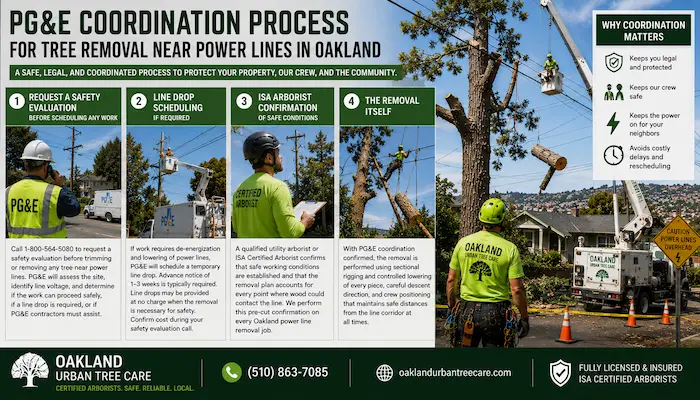
When a tree on your Oakland property needs to be removed and power lines are in or near the work zone, the coordination process with PG&E is non-negotiable and has specific steps that must be completed in order. Understanding this process sets accurate timeline expectations and prevents the job-day discoveries that lead to halted work and rescheduling costs.
PG&E’s published guidance asks property owners and tree crews to call 1-800-564-5080 to request a safety evaluation before trimming or felling any tree near power lines. PG&E will dispatch a representative to assess the site, identify which lines are present and what their voltage is, and determine whether the planned work can proceed safely, whether a temporary line de-energization and lowering is required, or whether PG&E’s own contractors will need to perform or assist with the work. Calling this number before scheduling any crew protects you legally and ensures the crew has the utility clearance needed to begin.
If the tree removal requires work within the clearance zone of a distribution line and that line cannot remain energized safely during the work, PG&E will schedule a temporary line drop: a planned de-energization and lowering of the affected line for the duration of the removal. Scheduling a line drop requires advance notice that typically runs one to three weeks. Line drops are not free in all circumstances but are often provided at no charge when the removal is genuinely required for safety. Confirm the cost, if any, during your initial PG&E safety evaluation call.
Before any crew member works within proximity of the confirmed line corridor, a qualified utility arborist or ISA Certified Arborist should confirm that the safe working conditions are established and that the crew’s planned method accounts for every point in the job where wood sections could contact the line during descent. Our team performs this pre-cut confirmation on every Oakland power line removal job as a standard operating procedure, not an optional addition.
With PG&E coordination confirmed and safe working conditions established, the physical removal follows the same principles as any other Oakland tree removal: sectional rigging and lowering of every section that could contact the line if dropped, careful control of wood descent direction throughout the job, and crew positioning that keeps all personnel at minimum safe distances from the line corridor. No crew member should be positioned above or below a section of wood that is being cut in close proximity to an energized line without confirmed working clearance.
Oakland’s geographic position at the edge of the California Wildland-Urban Interface means that significant portions of the city fall within the CPUC High Fire-Threat District map. Properties in the Oakland Hills, Montclair, Claremont, and areas above Highway 13 are frequently classified as CPUC Tier 2 or Tier 3 High Fire-Threat District. In these zones, PG&E is required to maintain enhanced vegetation clearances of at least 4 feet in all directions from distribution conductors, not the 18-inch minimum that applies in lower-risk areas.
For Oakland Hills property owners, the enhanced clearance requirement translates to more frequent and more aggressive PG&E vegetation management visits than in flatland neighborhoods. Trees in these zones are flagged for clearance trimming more quickly, the clearance zone around each line is larger, and PG&E’s authority under PRC 4293 to remove dead or hazardous trees that could fall into lines is exercised more actively. If you live in a High Fire-Threat District zone and have trees growing toward overhead lines, proactive communication with PG&E through their vegetation management reporting portal keeps you ahead of their inspection cycle and avoids the aggressive trimming that can result from deferred action.
In Oakland areas designated as State Responsibility Areas where CAL FIRE is the primary fire suppression agency, California Public Resources Code 4292 additionally requires a firebreak of 10 feet in radius around utility poles, removal of all tree limbs within that radius up to 8 feet above the ground, and removal of dead and diseased limbs to the conductor. In practice, much of residential Oakland falls under Oakland Fire Department jurisdiction rather than CAL FIRE State Responsibility Area designation, but hillside properties near the urban-wildland boundary may be in SRA territory. A professional tree health assessment that identifies whether your property falls within a Cal Fire SRA is a useful piece of the pre-removal planning process for hillside Oakland homeowners.
The liability picture for tree-meets-power-line incidents in Oakland depends on what caused the contact and what steps the property owner had taken before the incident.
If a structurally sound tree on your property falls onto a PG&E line during a storm event, your homeowners’ insurance and PG&E’s infrastructure insurance typically handle their respective portions: PG&E repairs its infrastructure at its own cost and your policy covers any property damage the fallen tree caused. California homeowners’ insurance policies generally cover removal costs when a tree falls and damages a covered structure as a result of a named storm peril.
When a tree that was visibly dead, diseased, or structurally compromised prior to a storm event falls into a power line, the liability picture changes significantly. If the property owner had documented prior knowledge of the tree’s hazardous condition, insurers and courts have found that the owner had a duty to act and failed to do so. PG&E has pursued cost recovery against property owners whose negligently maintained trees caused infrastructure damage and fire ignitions. The clearest protection is documented proactive management: a written arborist report confirming a tree’s hazardous condition, followed by permit application and scheduled removal.
If a tree crew you hire causes a power line contact or outage because they worked near the line without proper PG&E coordination, the legal exposure sits with both you as the property owner and the contractor. PG&E pursues cost recovery for infrastructure damage and restoration costs. If an injury occurs to a crew member or a neighbor from the energized line, the liability chain includes the property owner who directed or approved the work. Hiring a licensed, ISA-certified company that handles PG&E coordination as a standard part of their process is your protection against this scenario.
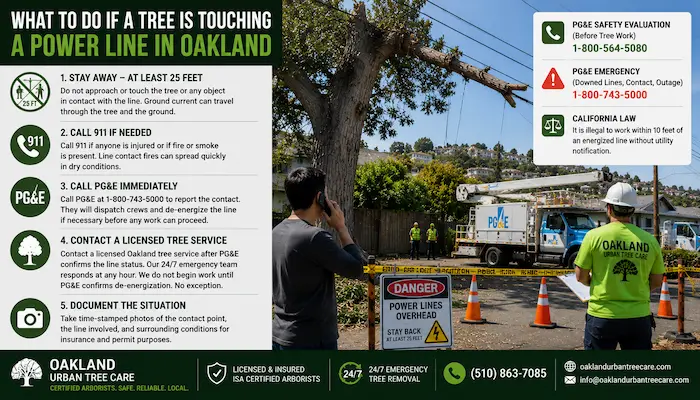
If you discover that a tree or large branch on your property is already in contact with or touching a power line, the immediate action sequence is clear and should not deviate.
The Number to Call Before Any Tree Work Near Oakland Power Lines PG&E Safety Evaluation (before tree work): 1-800-564-5080 PG&E Emergency (downed lines, contact, outage): 1-800-743-5000 California law makes it illegal to work within 10 feet of an energized distribution or transmission line without utility notification. Both numbers should be saved in your phone before you need them. |
The most expensive and stressful power line tree removal situations in Oakland are the ones that could have been anticipated and addressed before they became urgent. Several proactive steps protect both your property and your neighbors.
If you have trees with canopy growth approaching the 10-foot work zone around any power line on your Oakland property, schedule an annual professional tree health assessment to evaluate their trajectory. Growth of 1 to 3 feet per year in a fast-growing species like eucalyptus can bring a tree from safely distant to PG&E clearance zone in a single growing season. An annual assessment by an ISA Certified Arborist gives you accurate information about the pace of encroachment and the appropriate intervention timing.
Not every tree near a power line in Oakland needs to come down. In many cases, professional crown reduction pruning or directional trimming can manage the tree’s growth trajectory away from the line corridor and extend its safe life for many additional years. Crown reduction performed correctly by qualified arborists using ISA utility arboriculture standards removes the line-encroachment risk without losing the tree, preserving the shade, wildlife habitat, carbon storage, and property value that a mature Oakland tree provides. Our tree trimming and tree pruning teams work in line-proximity zones regularly and are fully trained in the safety protocols required for work near PG&E infrastructure.
For trees with structural defects such as co-dominant stems or significant lean toward a line corridor, tree cabling and structural support can reduce the probability of storm-driven failure that would cause line contact. Cabling is not a substitute for PG&E clearance management but is a complementary tool that reduces the dynamic load scenario that most commonly causes tree-line contact incidents during Diablo wind events and winter atmospheric rivers.
Tree removal near power lines in Oakland requires a company that has experience coordinating with PG&E, understands the California legal framework that governs utility tree work, and employs arborists trained in utility-proximity safety standards. At Oakland Urban Tree Care, we manage every aspect of power line tree removal from the initial PG&E safety evaluation request through permit coordination under Oakland’s Chapter 12.36, removal day execution with confirmed utility clearance, stump grinding, and replacement planting when permit conditions require it. Our full range of Oakland tree services includes tree removal, tree pruning, tree trimming, emergency tree service, tree health assessment, storm damage cleanup, tree cabling and structural support, and lot clearing. If you have a tree near power lines on your Oakland property, call us today before the situation becomes an emergency.
Call Oakland Urban Tree Care: +1 510 863 7085
Get Expert Power Line Tree Guidance at OaklandUrbanTreeCare.com