
Quick Answer Tree removal in Oakland takes 1 hour to 3 full days on the actual removal day, depending on tree size, species, access conditions, and whether structures are in the fall zone. Small trees under 30 feet typically take 1 to 3 hours. Medium trees from 30 to 60 feet take 3 to 7 hours. Large trees above 60 feet take one to two full days. But the physical removal day is only half the answer. Protected trees under Oakland Municipal Code Chapter 12.36 require a Non-Development Tree Removal Permit that takes 4 to 8 weeks to process before a single cut can legally begin. The total timeline from your first call to a finished, stump-ground site runs 6 to 10 weeks for a permitted removal and 1 to 5 business days for genuine hazard emergencies. |
Most people asking how long tree removal takes in Oakland are actually trying to answer a scheduling question: when will my yard be clear, when can I plan around the crew, and how much time should I block out? The honest answer has two parts that most guides online never explain together. There is the physical removal itself, where size and site access drive everything, and there is Oakland’s permit process, which adds weeks to the timeline for any tree protected under Chapter 12.36 but is non-negotiable and cannot be skipped. This guide covers both timelines completely so you know exactly what to expect from first call to final cleanup on your Oakland property.
Whether you have a towering eucalyptus on a steep Montclair lot or a medium-sized oak in a Temescal backyard, our ISA-certified arborists at Oakland Urban Tree Care provide free on-site assessments and give you a job-specific timeline based on your actual tree, your site, and your permit situation.
Oakland property owners consistently underestimate how long tree removal takes because they think about the job in one timeline when there are actually two, and only one of them is under your control once the process begins.
Oakland Municipal Code Chapter 12.36, the city’s Protected Tree Ordinance, requires a Non-Development Tree Removal Permit before removing any protected tree on private property including backyards, front yards, and side yards. There is no exemption for trees on your own land. The permit application is submitted to Oakland’s Bureau of Planning, Tree Services Division. Standard processing takes 4 to 8 weeks. Heritage tree reviews and applications requiring neighbor notification can take 8 to 16 weeks.
The protected species with the lowest and therefore most commonly triggered thresholds include coast live oak, valley oak, bay laurel, and California buckeye, all protected at just 4 inches diameter at breast height. That is a trunk circumference of roughly 12.6 inches, about the width of a soup can. Most mature specimens of these species in Oakland’s residential neighborhoods are well above that threshold. Before any crew can legally begin work on a protected tree, the written permit approval must be in hand. Scheduling work during the review period is a Chapter 12.36 violation that carries fines up to $1 million per tree, as Oakland’s highly publicized Claremont Avenue enforcement case demonstrated in 2026.
The two species commonly exempt from the permit requirement are eucalyptus globulus and Monterey pine, though Monterey pine removal still requires written notification to the city before any work begins. Our tree health assessment team confirms species and diameter as the first step of every permit consultation, because knowing which timeline applies to your tree determines everything that comes after.
Once permit approval is secured, the removal day is what most homeowners picture when they think about this question. This timeline is controlled by tree size, species and wood density, site access constraints, proximity to structures, soil and slope conditions, and whether PG&E line coordination was required. The sections below break each of these variables down with Oakland-specific time ranges that reflect the actual conditions of working across the city’s diverse residential neighborhoods.
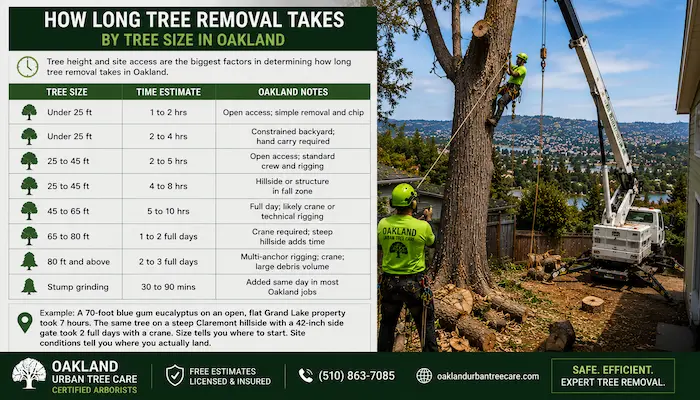
Tree height combined with site access is the most reliable starting point for estimating removal day duration. The table below reflects Oakland-specific experience across the full range of the city’s residential terrain, from the flat accessible lots of Fruitvale and East Oakland to the steep hillside properties of the Oakland Hills and Montclair.
Tree Size | Time Estimate | Oakland Notes |
Under 25 ft | 1 to 2 hrs | Open access; simple removal and chip |
Under 25 ft | 2 to 4 hrs | Constrained backyard; hand carry required |
25 to 45 ft | 2 to 5 hrs | Open access; standard crew and rigging |
25 to 45 ft | 4 to 8 hrs | Hillside or structure in fall zone |
45 to 65 ft | 5 to 10 hrs | Full day; likely crane or technical rigging |
65 to 80 ft | 1 to 2 full days | Crane required; steep hillside adds time |
80 ft and above | 2 to 3 full days | Multi-anchor rigging; crane; large debris volume |
Stump grinding | 30 to 90 mins | Added same day in most Oakland jobs |
A concrete Oakland example: a 70-foot blue gum eucalyptus on an open, flat Grand Lake property with direct street access was completed by a four-person crew in seven hours including stump grinding. The same species and height on a steep Claremont hillside property accessible only through a 42-inch side gate took two full days with a five-person crew and an over-the-fence crane setup. Size tells you where to start. Site conditions tell you where you actually land. Our tree removal team provides a specific time estimate during the free on-site assessment before any quote is issued.
Beyond tree height, seven site-specific factors consistently add time to Oakland tree removal jobs. Each one is worth understanding before you schedule work or accept a timeline estimate from any company.
The majority of Oakland residential properties have no vehicle access to the rear yard beyond a side gate measuring 36 to 48 inches wide. This single constraint transforms every Oakland backyard removal into a hand-carry operation. Log sections, branch bundles, and chip debris all move through this corridor on foot, one load at a time. For a 50-foot tree, that translates to dozens of individual trips through the gate before the site is clear. A tree that a crew could clear in four hours on an open-access lot can take seven or eight hours when the entire wood volume exits through a 40-inch passage.
Every structure within the fall zone of the tree changes the removal from a drop-cut operation to a fully rigged lowering operation. Drop cuts are fast. Rigged lowering, where each section is attached to a controlled line before it is cut and then lowered to the ground at a controlled pace, is safe and necessary but takes significantly more time per section. According to ISA rigging and removal standards, a crew performing rigged lowering needs at least one additional ground crew member on the lowering line for every climber working aloft. A tree clear of obstacles might take three hours. The same tree with a detached garage, a fence, and a neighboring structure in its fall zone can take seven or eight hours as every major piece is individually controlled and set down.
Steep slope conditions add time at every phase of the work. Climbing on an angled trunk is slower than climbing a vertical one. Debris placed on a slope will roll or slide if not immediately secured. Log sections cannot be set down and left without additional blocking. Crew members performing ground tasks work against gravity throughout the job and fatigue faster, slowing pace over the course of a long day. Oakland Hills and Montclair properties with slopes above 20 percent grade consistently run 30 to 50 percent longer than equivalent jobs on flat terrain.
When a tree is growing into or near a PG&E overhead distribution line, the utility must be notified before work begins. In cases where the tree has grown into the line corridor, a temporary line drop requires scheduling with PG&E in advance, which adds one to three weeks to the scheduling timeline before the removal day can be set. On the removal day itself, line proximity limits which cuts can be made in which sequence and may require a PG&E crew member on-site concurrently with the tree crew. Our team manages all PG&E notification and coordination as a standard part of pre-job planning on any project where utility proximity is identified.
Oakland’s most common large-tree species each have specific characteristics that affect removal speed. Blue gum eucalyptus produces enormous volumes of stringy fibrous debris that slows chipping and requires more passes per load than denser wood species. Valley oaks have heavy, spreading lateral limbs that require careful rigging sequencing to maintain the tree’s balance and center of gravity as each section comes off. Dead trees of any species are slower to remove than living ones because decayed wood is brittle and unpredictable, sections cannot be cleanly scored in the same way, and the structural instability of advanced decay prevents or slows safe climbing.
Large Oakland trees, particularly those on hillside properties or in positions where rope rigging alone cannot manage section weight safely, require crane-assisted removal. Crane setup takes 30 to 60 minutes at the start of the job, and crane breakdown takes a similar amount of time at the end. For hillside properties with restricted street access or tight turning radii, positioning the crane itself can take additional time. Crane operations during the removal are not inherently slower than rope rigging, but the crane must be repositioned as the work progresses around the tree, adding setup time at each position change.
The interior condition of a tree is not fully knowable before the first cut reveals it. A tree that appeared externally sound during the site assessment may show advanced heartwood decay, shell rot, or compromised root plate wood once cutting begins. When this happens, the entire removal plan must be adjusted: more rigging points, smaller sections to reduce load per cut, slower cutting pace, and more conservative load calculations throughout. This unplanned adjustment is one of the most common reasons Oakland tree removals extend past their initial time estimate. Our tree health assessment service includes a decay assessment with resistance testing on trees where external indicators suggest possible internal compromise, reducing the chance of mid-job surprises.
The table below represents the full end-to-end timeline for a typical Oakland permitted tree removal, from initial contact through permit approval, removal day, and final site completion.
Phase | Typical Timeline |
Initial call and booking free estimate | Same day to 2 business days |
On-site arborist assessment | 1 to 3 business days after contact |
ISA arborist report preparation | 3 to 7 business days |
Permit application submission | Day of or day after report is complete |
Oakland Non-Development Permit review | 4 to 8 weeks standard |
Heritage tree or contested review | 8 to 16 weeks or longer |
PG&E line drop scheduling if required | 1 to 3 additional weeks |
Removal crew scheduling after permit | 1 to 2 weeks based on availability |
Physical removal: small trees | 1 to 4 hours |
Physical removal: medium trees | 3 to 8 hours |
Physical removal: large and complex | 1 to 2 full days |
Stump grinding same day | 30 to 90 minutes additional |
Permit-required replacement planting | Within 90 days of removal completion |
TOTAL for standard permitted removal | 6 to 10 weeks from first call to finished site |
TOTAL for emergency hazard removal | 1 to 5 business days with fast-track documentation |
Oakland’s permit process does not mean every tree removal takes six to ten weeks. Trees that present an imminent and documentable hazard to life or property can qualify for an expedited pathway under Oakland’s Hazardous Tree Ordinance. The crucial requirement is that the hazardous condition must be documented in writing by a qualified professional before the fast-track process is available. You cannot self-certify an emergency. An ISA Certified Arborist must assess the tree, document the specific hazard it presents, and prepare a written report that supports the city’s expedited review.

Our 24-hour emergency tree removal team responds to Oakland emergencies at any hour, prepares the hazard documentation that the city’s expedited process requires, and can typically have a crew on site within 1 to 4 hours during daylight and 2 to 6 hours after dark depending on site conditions and crew availability. Following any emergency removal, our storm damage cleanup service handles the broader site assessment and debris clearance that often follows storm events across Oakland’s East Bay neighborhoods.
Important: Permit Approval Must Be in Hand Before Work Begins No matter how urgent the situation feels, the Non-Development Tree Removal Permit must be approved and in hand before any removal work legally begins on a protected tree in Oakland. The only exceptions are genuine documented emergencies under the Hazardous Tree Ordinance. A company that proceeds without confirming permit status exposes you to the same enforcement risk as if you had made that decision yourself. Our team confirms permit status on every single job before crew mobilization. |
Even well-planned Oakland tree removals encounter conditions that push the job past its scheduled date or extend the day beyond its estimated duration. Understanding these possibilities helps you build realistic schedule flexibility into your planning.
Professional arborists do not work aloft in unsafe wind conditions. Diablo wind events, dry northeast winds that develop rapidly over the East Bay Hills and routinely exceed 40 to 60 mph on exposed Oakland Hills ridgelines, can halt scheduled work without warning. The National Weather Service Bay Area office issues Diablo wind advisories and warnings for Alameda County that professional crews monitor closely. Atmospheric river storms arriving from November through April similarly create unsafe climbing and rigging conditions. Jobs scheduled in Oakland’s storm season from November through April carry a measurably higher risk of weather-related rescheduling than those scheduled in late summer and early fall.
The internal condition of any tree is not completely knowable before cutting begins. When the first sections come off a tree and reveal advanced heartwood decay, shell rot, or root plate compromise that was not visible externally, the removal plan must be slowed and revised. Smaller sections, additional rigging points, and more conservative load calculations add time that cannot be recovered on the same day. This is the most common cause of large Oakland tree removals extending from a planned one day to two days.
Blue gum eucalyptus, Oakland’s most common large-tree species, generates a remarkable volume of fibrous, stringy debris per unit of trunk volume. An 80-foot eucalyptus can produce five to seven full chipper loads of branch and bark material. When debris volume exceeds the initial estimate, cleanup extends correspondingly. On backyard jobs where all debris moves through a narrow gate corridor, the cleanup phase can be the longest single component of the entire removal day.
Tree removals that require access to neighboring properties for rigging anchor points or crane positioning need neighbor coordination to be completed before the removal day, not on the morning of. Discovering on removal day that a neighbor is unavailable or unwilling to allow access halts work at the phase where that access is needed and may require full rescheduling. Our team conducts neighbor coordination as part of the pre-job planning process for every job where adjacent property access is required or beneficial.
Oakland property owners have meaningful ability to reduce removal day duration and minimize the risk of unexpected delays with preparation steps that cost nothing but planning time.
Tree removal in Oakland takes longer than most homeowners expect, and the reason is almost always Oakland’s specific permit process combined with the site access constraints of the city’s hillside and infill residential properties. The physical removal day for most Oakland trees runs between two hours and two full days. The full project timeline from first call to finished site runs six to ten weeks for permitted removals, with the permit process accounting for the majority of that elapsed time. For genuine hazard emergencies, our fast-track response compresses the total timeline to one to five business days.
At Oakland Urban Tree Care, we manage every phase of this timeline for our clients: the tree health assessment and arborist report, the ISA Certified Arborist-prepared permit application, the removal with appropriate equipment for your specific site, stump grinding, and replacement planting when permit conditions require it. Our complete service range covers tree removal, tree pruning, tree trimming, emergency tree service, storm damage cleanup, tree cabling and structural support, and lot clearing. Call us today for a free on-site assessment and a job-specific timeline for your property.
Call Oakland Urban Tree Care: +1 510 726 2544