Quick Answer
Backyard tree removal in Oakland is more complex and more expensive than most homeowners expect because Oakland backyards combine three compounding challenges that are rare in other California cities: extremely limited equipment access on hillside and infill properties, Oakland’s strictest-in-the-Bay-Area permit requirements under Municipal Code Chapter 12.36, and a concentration of very large eucalyptus, oak, and pine species that require crane or technical rigging systems that simply cannot reach most Oakland backyards by truck. Expect a 25 to 50 percent premium above open-access pricing for constrained backyard jobs. Total project costs for backyard tree removal in Oakland typically run $1,000 to $4,500 for mid-size trees and $3,000 to $7,500 or more for large trees with access challenges.
Most tree removal cost guides give you a tidy national average and move on. They assume the crew can back a truck up to the base of the tree, drop the wood onto a flat surface, chip it into a waiting trailer, and drive away. That scenario describes almost none of Oakland’s residential backyards. In the Oakland Hills, Montclair, Rockridge, Temescal, and Grand Lake neighborhoods, the reality is typically something quite different: a rear yard accessible only through a side gate measuring 36 inches wide, a steep slope with no flat staging area, an 80-foot eucalyptus growing directly over a detached garage, and a neighboring property’s fence 12 feet from the trunk. Backyard tree removal in Oakland is a project that rewards planning and punishes assumptions.
This guide covers the full picture of backyard tree removal in Oakland: the specific access obstacles that define these projects and how crews work around them, how Oakland’s permit requirements apply to backyard trees, what the real cost drivers look like for constrained sites, how to prepare your property to reduce costs, and what questions separate a qualified local company from a crew that will leave you with an incomplete job, property damage, or a permit violation. If you are ready to get professional eyes on your backyard tree, our certified arborists at Oakland Urban Tree Care provide free on-site assessments across all Oakland neighborhoods.
Understanding why backyard tree removal in Oakland is categorically more complex than a standard removal is the foundation for making good decisions about planning, budgeting, and hiring. Three factors combine to create this complexity, and each one compounds the others.
Oakland was largely developed between 1890 and 1960, and the residential lot patterns of that era, combined with decades of subsequent development on hillside terrain, created a city where the vast majority of residential backyards have no direct vehicle access beyond a pedestrian side gate. Unlike suburban cities where rear yards back up to alleys or driveways loop around the property, Oakland’s residential fabric typically presents a single side passage of 36 to 48 inches that separates the front street access from the rear yard. Large equipment, including chippers, cranes, and log loaders, cannot enter this passage. Everything that leaves a backyard removal site goes out through this narrow corridor by hand, in pieces small enough for a worker to carry.
Hillside properties in the Oakland Hills, Montclair, and Claremont add slope as an independent complication. On properties where the backyard is significantly below street level, standard crane access may not be achievable at all, and rope systems anchored from the uphill side of the property are used to control sections during descent. Properties where the rear yard is significantly above street level present different challenges: equipment must be brought uphill, and debris must be carried or lowered back down.
Oakland’s dominant backyard tree species are not small ornamentals. Blue gum eucalyptus, valley oak, coast live oak, Monterey pine, and Canary Island pine dominate Oakland backyards and routinely reach 60 to 100 feet. Removing a 90-foot eucalyptus through a 40-inch gate in a hillside Montclair backyard is a fundamentally different technical challenge from removing a 30-foot flowering plum in an open lot. The larger the tree and the more constrained the access, the more expensive and time-intensive the removal becomes.
Many Oakland homeowners assume that backyard trees, being on private property and not visible from the street, are outside the scope of the city’s permit requirements. This assumption is incorrect. Oakland’s Municipal Code Chapter 12.36 applies explicitly to trees on private property including backyards. A coast live oak growing behind your Rockridge home that meets the 4-inch diameter at breast height threshold is protected and requires a Non-Development Tree Removal Permit before any crew can legally begin work. The location of the tree within your property does not affect the permit requirement.
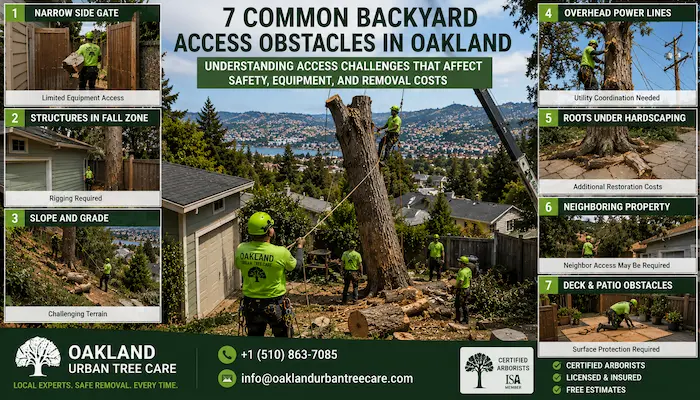
Every backyard removal site in Oakland has a unique access profile, but the same seven obstacles appear repeatedly across the city’s residential neighborhoods. Understanding which of these applies to your property is the first step in getting an accurate quote.
The most universal Oakland backyard obstacle is the side gate. Standard residential side passages in Oakland measure 36 to 48 inches wide, wide enough for a single worker with a chainsaw but not for any wheeled equipment. Every piece of wood that leaves through this passage goes by hand carry, one section at a time. For a large tree, this constraint alone can add two to four hours of labor to the job compared to a site with open vehicle access. Some properties have gates that can be temporarily removed or hinged sections of fence that can be opened to create a wider passage. Identifying this possibility before the crew arrives reduces total labor time and cost.
Backyard trees in Oakland frequently grow in close proximity to detached garages, accessory dwelling units, sheds, pergolas, and neighboring structures. Any structure within or near the fall zone of the tree requires that every section of the tree be rigged and lowered rather than dropped. Rigged lowering is safer and necessary, but it is significantly slower and requires additional crew to manage the lowering lines. A tree adjacent to a structure that could be lowered in four hours on an open site may take eight or more hours when every piece must be rigged, lowered, and then hand-carried through the access corridor.
Oakland’s hillside neighborhoods are extensive. Backyards on properties with significant slope present challenges in both directions. Downslope properties require careful calculation of where wood will travel when it falls and what is directly below the work zone. Upslope properties require that crew members work against gravity during both the removal and the debris removal phases. Loose soil on steep slopes also creates footing hazards that affect the pace and method of the work. Slope is consistently one of the three largest cost drivers in Oakland backyard tree removal.
Power distribution lines in Oakland’s residential neighborhoods frequently run through backyard spaces, particularly along the rear property lines where utilities are easiest to route. A backyard tree growing toward or into a power line corridor must be removed with the line in mind. PG&E may need to be notified before work begins, and a temporary line drop, where the utility briefly de-energizes and lowers the lines to allow the crew to work safely, may be required. Line drop requests must be scheduled with PG&E in advance and can add one to three weeks to project scheduling. Our team manages PG&E coordination as part of the pre-job planning process on every project with utility proximity.
Large trees in Oakland backyards often have extensive surface root systems that have grown beneath pavers, concrete paths, and patio slabs over decades. The removal of the tree does not remove these roots, and stump grinding typically addresses the visible root flare but does not process roots that run under hardscaping. If your goal is to restore a flat, usable surface after the tree removal, budget separately for root removal work under any hardscaping within the root zone, which can extend 20 to 30 feet from the trunk in mature specimens.
Oakland’s residential lots are compact, and backyard trees frequently overhang or closely approach neighboring properties, fences, and structures. Removal of a tree with significant overhang into a neighboring yard typically requires coordinating access to the neighbor’s property for rigging anchor points or for the crew to work from the adjacent side. Neighbor coordination is a professional responsibility that your tree service should manage, but it requires notice, scheduling flexibility, and sometimes a separate access arrangement. A company that does not discuss neighboring property proximity during the site assessment has not fully evaluated your job.
Many Oakland backyards include decks, raised patios, or permeable paving that cannot support the weight of large log sections or wheeled equipment. A large trunk section dropped onto a deck surface can cause structural damage that costs more to repair than the tree removal itself. Professional crews place cribbing and load-spreading mats to protect deck and patio surfaces during lowering operations. Confirm that your contractor specifically addresses deck and surface protection in their proposal. This is not optional on Oakland jobs where backyard decks sit beneath or adjacent to the work zone, and our tree removal team includes structural surface protection in every constrained backyard removal.
Professional Oakland tree removal companies have developed specific techniques and equipment configurations for constrained backyard access that differ meaningfully from the standard open-site removal approach. Understanding these methods helps you evaluate contractor proposals and set realistic expectations for what the job will look like.
For trees on sites with no vehicle access, the entire volume of wood and debris moves out by hand. Branch material is processed with a chainsaw into sections that fit through the access passage, then carried to the chipper positioned at the street. Log sections are cut to manageable weights and carried out one at a time. This process is labor-intensive and represents the core reason why constrained Oakland backyard removals cost significantly more per tree than open-access jobs of equivalent tree size.
A growing number of Oakland tree removal companies, including our team, have invested in compact lift equipment that can pass through narrower access points than standard cranes. Micro-cranes with outrigger-stabilized bases can sometimes be walked through a 48-inch gate on level ground and deployed in a rear yard for lift-and-lower operations that would otherwise require a full-size crane at the street. This equipment does not replace hand carry for all site configurations, but it significantly expands the range of sites where mechanical lifting assistance is available.
For backyard trees where no equipment can access the rear yard at all, certified climbers establish rigging systems using the tree itself, adjacent trees, or anchored rigging points to control each section’s descent. According to ISA rigging and removal guidelines, every rigging configuration must be calculated for the expected load before cuts are made. An ISA Certified Arborist on the crew ensures these calculations are made correctly for Oakland’s specific site conditions, including hillside grade, soil anchor reliability, and the structural condition of any adjacent trees used as rigging points.
For backyard trees where a crane can be positioned in an adjacent alley, neighboring property, or accessible side lot, over-the-fence crane operations allow large sections to be lifted clear of backyard obstacles and set down in the street for processing. This method is particularly effective for large trees in Oakland’s flatter East Oakland neighborhoods where rear alleys or wider side passages allow crane positioning. On hillside properties, the crane reach required is typically greater, and crane selection must account for both the lift weight and the extended reach distance.
Oakland’s Non-Development Tree Removal Permit requirement applies to backyard trees without qualification. The 4-inch diameter at breast height threshold for coast live oaks, valley oaks, bay laurels, and California buckeyes is the same whether the tree is in a front yard, a back yard, or behind a solid fence that no neighbor can see. The $434.20 base permit fee, the 4 to 8 week review timeline, and the ISA arborist report requirement apply equally to all protected trees regardless of their location within the property.
There is one sense in which a backyard tree can move through the permit process more smoothly than a street-facing tree: neighbor notification requirements. Some Oakland permit applications require notification of adjacent property owners who have a visible interest in the tree being removed. A backyard tree fully enclosed within a walled or fenced yard with no visual access from neighboring properties may be subject to a shorter or less involved notification process. Confirm this with the Bureau of Planning during the pre-application phase, as it depends on the specific site configuration and tree visibility.
If a backyard tree presents an immediate hazard, such as significant lean toward a structure, root plate upheaval, or advanced structural failure, the expedited hazardous tree process is available. This requires written documentation from a qualified arborist confirming the imminent hazard. Our tree health assessment team prepares the hazard documentation that Oakland’s fast-track process requires. We have managed numerous backyard hazard tree removals under the expedited pathway, coordinating the documentation, the permit notification, and the removal scheduling in a compressed timeline appropriate to the urgency of the situation.
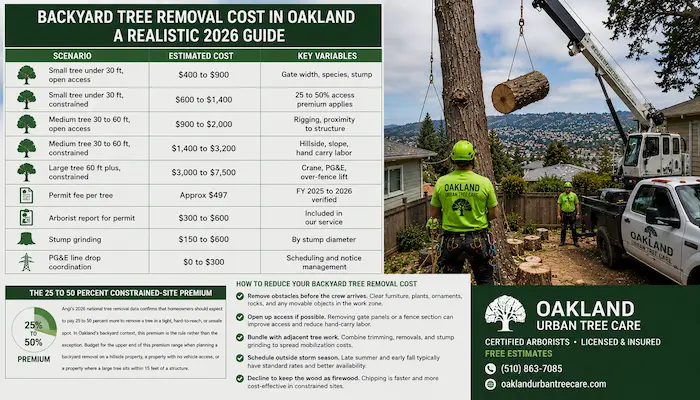
Oakland backyard tree removal costs reflect a combination of tree size, species, site access complexity, and the permit overhead that all legitimate removals include. The ranges below are Oakland-specific and account for the constrained-site premiums that national averages consistently omit.
Scenario | Estimated Cost | Key Variables |
Small tree under 30 ft, open access | $400 to $900 | Gate width, species, stump |
Small tree under 30 ft, constrained | $600 to $1,400 | 25 to 50% access premium applies |
Medium tree 30 to 60 ft, open access | $900 to $2,000 | Rigging, proximity to structure |
Medium tree 30 to 60 ft, constrained | $1,400 to $3,200 | Hillside, slope, hand carry labor |
Large tree 60 ft plus, constrained | $3,000 to $7,500 | Crane, PG&E, over-fence lift |
Permit fee per tree | Approx $497 | FY 2025 to 2026 verified |
Arborist report for permit | $300 to $600 | Included in our service |
Stump grinding | $150 to $600 | By stump diameter |
PG&E line drop coordination | $0 to $300 | Scheduling and notice management |
Angi’s 2026 national tree removal data confirms that homeowners should expect to pay 25 to 50 percent more to remove a tree in a tight, hard-to-reach, or unsafe spot. In Oakland’s backyard context, this premium is the rule rather than the exception. The majority of Oakland backyard tree removals involve at least one significant access constraint, and many involve three or four simultaneously. Budget for the upper end of this premium range when planning a backyard removal on a hillside property, a property with no vehicle access, or a property where a large tree sits within 15 feet of a structure.
In a constrained Oakland backyard, the proximity of structures, surfaces, and plantings to the work zone makes property protection planning an essential part of every job. A professional crew addresses this systematically before any cuts begin.
Any structure within the work zone receives specific protection measures before removal begins. Foam or rubber pads protect roof edges, fascia, and gutters from incidental contact with rigged sections. Cribbing boards protect deck surfaces from log section weight. Drip-edge flashing and projecting roof features are assessed and padded where rigged sections will pass nearby. These measures are not optional on Oakland backyard jobs where clearances between tree and structure are often measured in feet rather than yards.
Many Oakland backyards contain established garden beds, native plant installations, fruit trees, and irrigation systems that represent years of investment. Before removal work begins, identify any planting beds or irrigation infrastructure within the work zone and discuss with the crew how they will be protected or temporarily removed. A crew that arrives without discussing this is not fully prepared for your specific site.
If your backyard shares a fence with neighboring properties and removal work will require access to or visual exposure of the neighboring yard, notify neighbors in advance. Professional notification, rather than work that simply appears over a shared fence line, prevents the complaints and disputes that slow down or halt ongoing work. Our team manages neighbor notification as part of every backyard job where adjacent property contact or visibility is part of the site configuration.
Question | Why It Matters |
What is your CSLB C49 license number? | Verify at cslb.ca.gov; unlicensed crews carry no liability |
Have you worked on sites with similar access constraints? | Backyard experience is not interchangeable with open-lot experience |
How will sections be removed from the rear yard? | Tests whether crew has a genuine plan for your specific access |
Is deck and surface protection included? | Unprotected drops on backyard decks cause expensive damage |
Will you manage the Oakland permit application? | Confirm they know the Chapter 12.36 requirements |
Is stump grinding included or quoted separately? | Prevents surprise charges after the tree is down |
Do you carry liability and workers’ comp insurance? | Request actual certificates; verbal claims are not sufficient |
Will an ISA arborist assess the site before work starts? | Pre-cut site assessment is standard practice for complex jobs |
Red Flag: The Crew That Skips the Site Visit
Any company that quotes a backyard tree removal without visiting the site is not pricing your actual job. They are pricing a hypothetical. Backyard access variations in Oakland are substantial enough that a phone quote or online estimate can differ from the actual job cost by 40 percent or more. Always require an in-person site visit before accepting any quote, and treat any contractor who refuses this step as unqualified for the work.
Backyard tree removal in Oakland is a project that succeeds or fails in the planning phase. The physical challenges of constrained access, steep terrain, proximity to structures, and PG&E infrastructure are all manageable when a qualified crew has assessed the site honestly and planned the job with the right equipment, the right method, and the right permit status confirmed in advance. They become expensive and dangerous when a crew arrives without having accounted for them.
At Oakland Urban Tree Care, every backyard tree removal begins with a free on-site assessment by an ISA Certified Arborist who evaluates access, identifies structural hazards, confirms permit requirements, and develops a removal plan specific to your site’s actual conditions. We handle Oakland’s permit process from application to approval, manage PG&E coordination when required, protect your structures and garden spaces throughout the job, and complete the project with stump grinding and full site cleanup as standard. Our full range of Oakland tree services includes tree removal, tree pruning, tree trimming, emergency tree service, tree health assessment, storm damage cleanup, tree cabling and structural support, and lot clearing. Call us today for a free backyard removal estimate.
Call Oakland Urban Tree Care: +1 510 726 2544
Get a Free Backyard Tree Removal Estimate at OaklandUrbanTreeCare.com
