Quick Answer
Dead tree removal in Oakland should never be postponed. A dead tree loses structural integrity rapidly and can fall without warning, even on calm days with no wind. In Oakland’s specific environment, dead trees carry three compounding risks: they become critical fire hazards under Cal Fire’s defensible space requirements, they attract wood-boring pests like the goldspotted oak borer that can spread to neighboring live trees, and they still require a Non-Development Tree Removal Permit under Oakland Municipal Code Chapter 12.36 before removal can legally begin. Waiting does not reduce the permit requirement. It only increases the physical danger, your personal liability, and the cost and complexity of the removal itself.
Dead tree removal in Oakland is one of those tasks where every week of delay makes the situation measurably worse. A dead oak standing at the edge of your Rockridge yard is not a stable object waiting patiently for your attention. It is a structure undergoing continuous degradation: internal wood decay spreading outward from the heartwood, bark separating from the cambium, root plate losing its grip in the soil, and large branches becoming increasingly brittle and detached. When that tree eventually comes down, whether in a Diablo wind event, a winter atmospheric river storm, or simply from its own structural collapse on a still afternoon, it will not warn you first.
This guide covers the complete picture of dead tree removal in Oakland: why dead trees deteriorate faster than most homeowners expect, the specific hazards that make early removal so critical in Oakland’s environment, how the city’s permit process works for dead trees, what the removal costs and timeline look like, and what happens if you wait too long. If you already have a dead tree on your Oakland property that needs immediate assessment, call our ISA-certified arborists at Oakland Urban Tree Care today for a free on-site evaluation.
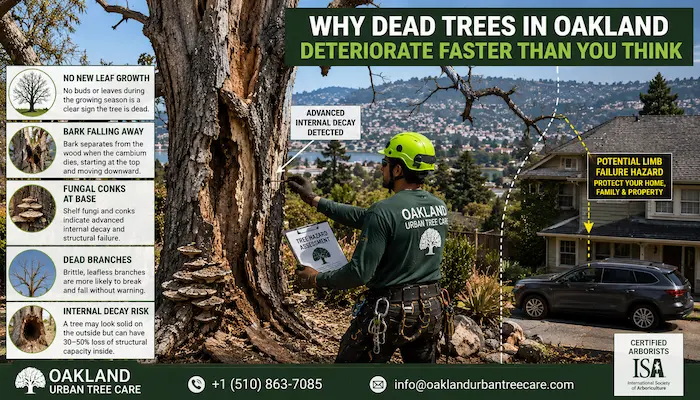
Many Oakland homeowners treat a dead tree the way they treat a broken fence or a cracked driveway: something to deal with eventually, when there is time and budget. This comparison fundamentally misunderstands what a dead tree is doing structurally. A fence does not actively weaken itself. A dead tree does, and it does so at a pace that accelerates over time.
In the first year after a tree dies, visible decay is often minimal. The bark remains attached, the branching structure looks largely intact, and the tree may still hold its shape convincingly. This appearance is deeply misleading. Internally, moisture loss is drying out the wood fibers that give the tree its tensile strength. The cambium layer between the bark and sapwood, the living tissue that maintained water transport, is dead and beginning to separate. Root hairs that maintained soil anchorage are dying off.
By year two, the separation between bark and wood becomes more visible, large dead branches begin detaching from junctions, and the first wood-decay fungi begin establishing colonies in the exposed wood. By year three, internal decay in the heartwood may be extensive even when the outer shell of the trunk still looks solid. This is the most dangerous phase: a tree that looks structurally substantial from the outside but has lost 30 to 50 percent of its internal structural capacity. Professional arborists call this condition a “shell tree,” and it can fail catastrophically with almost no external warning.
After year four, structural failure is no longer a matter of if but when. The timing is determined by load events: a Diablo wind event accelerating to 50 mph across an Oakland Hills ridge, the saturation of the root plate zone during a winter atmospheric river, or simply the progressive weight of the crown exceeding what decayed wood can support. According to ISA tree hazard evaluation standards, trees with advanced internal decay present a high probability of sudden failure and should be treated as urgent removal priorities regardless of their external appearance.
Oakland’s Mediterranean climate creates specific conditions that accelerate dead tree deterioration faster than in many other regions. The wet season, running November through April, repeatedly saturates soils around the root plate and encourages rapid fungal colonization of dead wood. The dry season from June through October desiccates dead wood to near-tinder consistency, maximizing both brittleness and fire fuel value. This wet-dry cycling, repeated annually, stresses dead wood at a pace that dead trees in more consistently humid climates do not experience. What might take five to seven years to reach critical failure risk in Seattle or Portland can reach the same failure risk in three to four years in Oakland’s cycling climate.
Distinguishing a truly dead tree from one going through a temporary stress response is not always straightforward, and misidentifying a stressed but recoverable tree can lead to unnecessary dead tree removal. Schedule a professional tree health assessment if you are uncertain. However, several signs consistently indicate a tree has crossed from stressed to dead.
Do Not Rely on Leaf Color Alone
In Oakland’s dry season, water stress and certain diseases can cause premature browning that mimics dead tree appearance without the tree actually being dead. Conversely, some dead trees retain their dried brown leaves for months, creating the false impression that the tree is still physiologically active. A professional assessment that includes a cambium scratch test, twig break test, and root collar evaluation is the only reliable way to confirm death versus severe stress in ambiguous cases.
Dead tree removal in Oakland is urgent for reasons that go beyond the general structural failure risk that applies anywhere. Oakland’s specific geography, climate, regulatory environment, and pest ecology create a set of compounding hazards that make a dead tree on an Oakland property significantly more dangerous than the same tree would be in most other California cities.
Oakland sits at the edge of California’s Wildland-Urban Interface, and the memory of the 1991 Oakland Hills firestorm, which killed 25 people and destroyed nearly 3,500 homes, shapes the city’s fire safety culture in ways that are embedded in both regulation and community norms. Dead trees are among the highest-priority fire hazards in Oakland’s environment. Their fully desiccated wood ignites readily, burns intensely, and sustains combustion that can carry ground fire into the aerial canopy pathway that makes urban-wildland fires so devastating. Under Cal Fire’s defensible space requirements, property owners in Oakland’s Wildland-Urban Interface zone, which includes the Oakland Hills, Montclair, and Claremont neighborhoods, are required to maintain their property in compliance with vegetation management standards that explicitly include dead tree removal. Annual Cal Fire inspections in these zones result in compliance notices that can escalate to fines if not addressed.
Dead and dying trees in Oakland are not just hazards in themselves. They are establishment sites for pest species that can spread to adjacent live trees and cause loss well beyond the original dead specimen. The goldspotted oak borer (Agrilus auroguttatus) is an invasive beetle that has killed tens of thousands of oak trees in the East Bay and Southern California. It preferentially attacks weakened and dying oaks, using them as breeding habitat from which populations spread to neighboring healthy trees. Ambrosia beetles, which spread fungal pathogens through the vascular tissue of oaks and other hardwoods, similarly use dead and stressed trees as entry points into otherwise healthy urban forests. Leaving a dead oak in place on your Oakland property is not a neutral act. It is providing a breeding site from which pest populations expand to your healthy trees and potentially those of neighboring properties.
California property law places a duty of care on property owners to address known hazards on their land. A dead tree is a textbook known hazard: it is visible, its risk of falling is foreseeable, and its potential to cause damage is obvious. If a dead tree on your Oakland property falls and causes injury or property damage, including to a neighbor’s home, vehicle, or person, your insurer will investigate when you knew the tree was dead and whether you took reasonable steps to address the hazard. Insurers routinely deny claims or pursue recovery against property owners who were aware of a tree’s hazardous condition and did not act. A written record showing you contacted a professional arborist and initiated the permit process is your strongest protection.
Oakland’s two primary storm hazard patterns affect dead trees with particular severity. Diablo wind events, dry northeast winds that can reach 70 mph or more on exposed Oakland Hills ridgelines, impose sudden high lateral loads on dead trees whose wood has lost the flexibility to absorb wind energy. Dead trees snap rather than sway, and the resulting wood sections become high-energy projectiles rather than controlled falls. Atmospheric river storms saturate soils for weeks at a time, progressively reducing the root plate anchorage of dead trees whose root systems have begun to decay. The combination of compromised root anchorage and saturated soil significantly reduces the wind resistance threshold at which a dead tree will uproot completely.
One of the most persistent misconceptions Oakland homeowners carry about dead tree removal is that a dead tree is automatically exempt from the city’s permit requirements. It is not. Oakland Municipal Code Chapter 12.36 does not create an exception for dead trees. If the tree was a protected species, such as a coast live oak, valley oak, bay laurel, or California buckeye, at the time it died, it remains subject to the permit requirement regardless of its current condition. The Non-Development Tree Removal Permit must be obtained before removal work begins.
For dead trees that present an imminent and documentable hazard to life or property, Oakland provides a faster review pathway under the city’s Hazardous Tree Ordinance. This process allows the review timeline to be compressed significantly compared to the standard 4 to 8 week Non-Development permit process. However, the fast-track pathway requires written documentation from a qualified professional confirming the hazardous condition. You cannot self-certify a tree as hazardous. An ISA-certified arborist must assess the tree, document the specific hazards it presents, and prepare a written report supporting the expedited review.
Although the permit requirement still applies, Oakland’s reviewers consistently approve dead tree removal permits faster and with less friction than permits for healthy trees removed for convenience or development-related reasons. The justification is clear and documented, and reviewers do not need to weigh the ecological loss of a living tree against the removal rationale. A well-prepared application from an ISA Certified Arborist that clearly documents the tree’s dead status, the specific hazards it presents, and the recommended removal method typically moves through review without significant challenges.
In May 2026, Oakland City Council voted to impose fines approaching one million dollars on property owners on Claremont Avenue who removed 38 protected trees without permits. Significantly, the property owner stated at the City Council hearing that some of the removed trees were dead, dying, or hazardous. As KQED reported, the claimed condition of the trees did not exempt them from the permit requirement or shield the owners from enforcement action. The condition of a tree is a factor the permit application addresses. It does not replace the application.
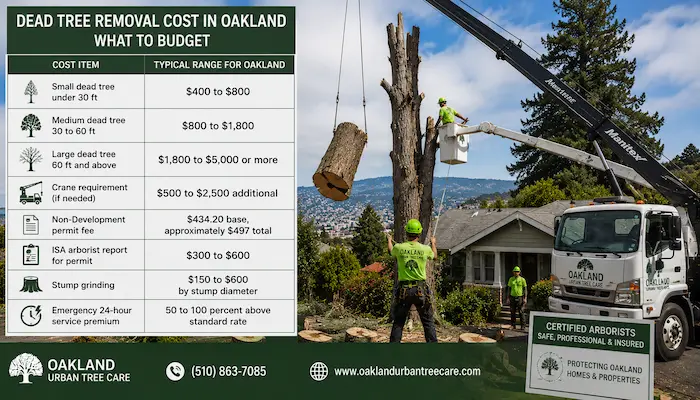
Cost Item | Typical Range for Oakland |
Small dead tree under 30 ft | $400 to $800 |
Medium dead tree 30 to 60 ft | $800 to $1,800 |
Large dead tree 60 ft and above | $1,800 to $5,000 or more |
Crane requirement (if needed) | $500 to $2,500 additional |
Non-Development permit fee | $434.20 base, approximately $497 total |
ISA arborist report for permit | $300 to $600 |
Stump grinding | $150 to $600 by stump diameter |
Emergency 24-hour service premium | 50 to 100 percent above standard rate |
Many homeowners assume that dead trees are simpler and cheaper to remove than living ones. This is often wrong, and for specific reasons that are worth understanding before you receive quotes. Dead wood is brittle and unpredictable in ways that healthy wood is not. A cut that would produce a controlled fall in a living tree can cause a dead section to shatter or kick unpredictably, because the wood fibers lack the moisture content that gives living wood its tensile predictability. Dead trees with significant internal decay often cannot be safely climbed, forcing crews to use crane-assisted removal even for trees that would normally be handled with rope rigging. The combination of brittleness, unpredictability, and structural compromise often means a dead tree requires more equipment and more highly skilled crew time than its living equivalent.
If a dead tree on your Oakland property partially fails in a storm and becomes an immediate hazard, you are now dealing with emergency dead tree removal, and emergency rates apply. Oakland emergency tree service providers typically charge 50 to 100 percent above standard rates for after-hours, weekend, and urgent same-day responses. Our 24-hour emergency tree service is available every day of the year, including during and immediately after storm events. The financial comparison is straightforward: proactive dead tree removal at standard rates versus reactive emergency removal at premium rates, plus the potential property damage costs if the tree comes down before the crew arrives.
Homeowners’ insurance and dead tree removal intersect in two important ways that Oakland property owners should understand clearly.
Standard homeowners’ insurance in California does not cover the cost of proactive removal of a dead tree that has not yet fallen. Tree removal coverage under most policies is triggered by a covered peril, such as a storm, causing the tree to fall and damage a covered structure. If you remove a dead tree before it falls, you pay out of pocket. This is the correct decision financially and from a liability standpoint, but it will not be reimbursed by your insurer.
When a dead tree falls and damages your property or a neighbor’s property, the insurer will investigate whether you had prior knowledge of the tree’s hazardous condition. If your own records, a prior arborist report, a neighbor’s complaint, or any documented communication indicates you knew the tree was dead and had not acted, the insurer may deny coverage or reduce the claim on grounds of negligence. A documented pattern of professional tree care, including a written health assessment that confirms the tree’s condition and recommends removal, is your protection against this scenario. It demonstrates due diligence and shifts the narrative from neglect to managed process.
Understanding the removal process helps Oakland homeowners set realistic expectations and evaluate contractor proposals before committing to any company.
Before any cuts are made, a professional crew performs a site assessment that evaluates the tree’s structural condition, identifies the primary failure risks in the specific dead wood, determines whether the root plate is stable enough to support rigging loads during sectional removal or whether crane assistance is required, and identifies structures, utilities, and other assets in the fall and drop zone. Our ISA-certified arborists lead this assessment on every dead tree removal job, because the pre-cut evaluation determines every subsequent decision.
For dead trees where rope rigging can safely manage section weights and the root plate is stable enough to support the rigging anchor loads, sectional removal from the crown downward is the standard method. For dead trees with advanced internal decay, severely compromised root plates, or locations where conventional rigging would create unacceptable risk to surrounding structures, crane-assisted removal is used. Dead trees with advanced shell decay frequently require crane assistance even at modest sizes because internal decay prevents the use of climbing spurs and undermines the anchor reliability of rigging setups.
After the trunk and crown are processed and removed, the stump remains. Our stump grinding service grinds the stump to below grade level, preventing the root system from becoming a structural void as it decays and eliminating the visible reminder of the removal. Stump grinding is coordinated as part of every dead tree removal job we perform, handled in the same crew mobilization to minimize cost and site disruption. If replacement planting is part of your permit conditions or your own property plans, our tree planting and urban tree care team coordinates the replacement species selection and installation.
Dead tree removal is the beginning of a property restoration process, not the end of it. Several follow-on steps protect the site and improve your property’s long-term condition.
Every week a dead tree stands on an Oakland property is a week closer to a structural failure event that could have been avoided. The permit process is not an obstacle to action; it is a defined, manageable pathway that legitimate companies navigate routinely and that our team handles from first call to final approval. The cost of proactive dead tree removal is predictable and manageable. The cost of waiting: emergency removal rates, potential property damage, pest spread to adjacent trees, fire season compliance issues, and insurance complications is none of those things.
Dead tree removal in Oakland is not a decision to revisit next season. If you have a dead or significantly declining tree on your property, contact Oakland Urban Tree Care today for a free on-site assessment. Our ISA Certified Arborist team will evaluate the tree’s condition, confirm whether it is protected under Chapter 12.36, prepare the permit application documentation, and give you a clear, transparent quote for the complete removal process including stump grinding and replacement planting. Explore our complete service range: tree removal, emergency tree service, tree health assessment, tree pruning, storm damage cleanup, and tree trimming.
Call Oakland Urban Tree Care: +1 510 863 7085
