Quick Answer Yes. In most cases, you do need a permit to remove a tree on your own property in Oakland, CA. Oakland’s Municipal Code Chapter 12.36, the Protected Tree Ordinance, requires a Non-Development Tree Removal Permit before removing any protected tree regardless of whether it sits on private property, a front yard, or a back yard. Protection thresholds are species-specific: coast live oaks, valley oaks, bay laurels, and California buckeyes are protected at just 4 inches diameter at breast height (DBH), the strictest threshold in the Bay Area. All other native species are protected at 9 inches DBH. The two main exemptions are eucalyptus globulus (blue gum) and Monterey pine, though Monterey pine removal still requires written notification to the city. Permit fees start at $434.20. Violations carry penalties up to $1 million per tree. |
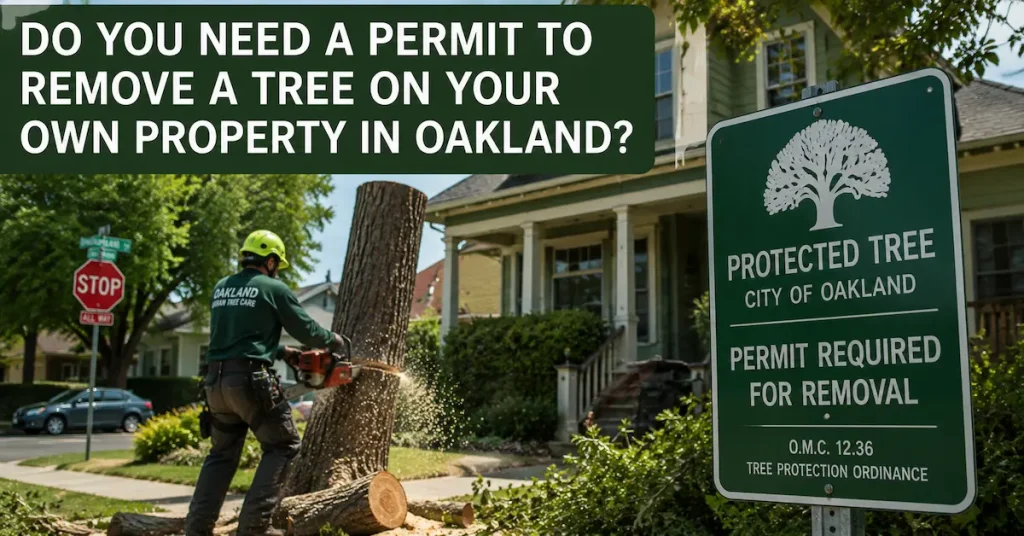
It is one of the most common assumptions in Oakland and it leads to one of the most costly mistakes a property owner can make: the belief that because a tree is on your land, you have the automatic right to remove it. That assumption is wrong in Oakland, and the consequences of acting on it can be financially devastating.
Oakland enforces the strictest private-property tree protection ordinance in the entire Bay Area. A 4-inch diameter oak in your backyard is legally protected whether you planted it, inherited it, or have been meaning to remove it for years. The city does not require that the tree be large, heritage, or even particularly old to receive legal protection. What it requires is that you go through a defined process before you touch it, and that process begins with a permit.
This guide answers the question completely, clearly, and for every common scenario Oakland property owners encounter: the backyard oak, the front-yard tree that is lifting your driveway, the dead tree that seems obviously past saving, the tree near a construction project, and the ones everyone assumes are exempt. Whether you are a homeowner, a buyer doing due diligence, or a property owner who already has a situation on your hands, everything you need to know is here. And when you are ready to move forward with proper compliance, our licensed Oakland tree removal team handles permits, assessments, and removals from start to finish.
California does not have a statewide private-property tree removal permit requirement, so many Oakland homeowners assume their city follows the same general permissive approach. It does not. Oakland made a deliberate policy choice decades ago to extend tree protection to trees on private land, not just street trees or park trees, and that decision is enforced actively.
The legal authority for this is Oakland Municipal Code Chapter 12.36, the Protected Tree Ordinance. It states clearly that a Non-Development Tree Removal Permit is required to remove trees on public or private property, including front and back yards. The city’s own Tree Removal Permit Application page repeats this without qualification. The only routes around this requirement are the species-based exemptions, the emergency fast-track process for genuinely imminent hazards, and situations where the tree genuinely does not meet the protected threshold by species and size.
To understand why Oakland’s approach is so much stricter than neighboring cities, you have to understand October 20, 1991. The Oakland Hills firestorm killed 25 people, destroyed nearly 3,500 homes, and burned more than 1,500 acres across the Oakland Hills and Piedmont. In the decades following that disaster, Oakland developed both a strong commitment to urban canopy restoration and a specific policy framework that treats significant trees as community infrastructure rather than private property features that owners control unilaterally. The 4-inch DBH protection threshold for oaks is a direct expression of that history.
Neighboring Berkeley protects oaks at 6 inches DBH. San Leandro’s thresholds are larger still. Oakland at 4 inches is the strictest in the region, and the city enforces it with penalties that are among the highest in California.
The protected status of a tree on your property depends on two things: what species it is and how large its trunk is. If a tree meets both criteria for its species category, it is protected and requires a permit before removal, relocation, or significant pruning.
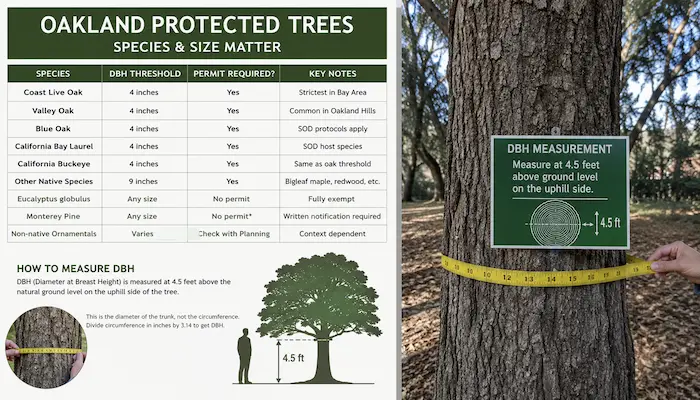
DBH stands for diameter at breast height, and it is measured at exactly 4.5 feet above the natural ground level on the uphill side of the tree. This is the diameter of the trunk, not the circumference. Many homeowners measure circumference with a tape measure and mistake the number for DBH. To convert: divide circumference in inches by 3.14 to get DBH. A trunk that measures 12.6 inches around has a DBH of approximately 4 inches, which is the exact protection threshold for oaks. When in doubt, request a professional measurement from a certified arborist before assuming a tree is or is not protected.
Species | DBH Threshold | Permit Required? | Key Note |
Coast Live Oak | 4 inches | Yes | Strictest in Bay Area |
Valley Oak | 4 inches | Yes | Common in Oakland Hills |
Blue Oak | 4 inches | Yes | SOD protocols apply |
California Bay Laurel | 4 inches | Yes | SOD host species |
California Buckeye | 4 inches | Yes | Same as oak threshold |
Other native species | 9 inches | Yes | Bigleaf maple, redwood, etc. |
Eucalyptus globulus | Any size | No permit | Fully exempt |
Monterey Pine | Any size | No permit* | Written notification required |
Non-native ornamentals | Varies | Check with Planning | Context dependent |
Eucalyptus globulus, the blue gum eucalyptus that dominates many Oakland Hills landscapes, is fully exempt from the permit requirement. This surprises many people given how large and numerous these trees are throughout the East Bay. The exemption dates to Oakland’s post-1991 fire recovery strategy, during which blue gum eucalyptus was identified as a significant fire fuel and its removal was actively encouraged rather than regulated. That policy position persists in the ordinance today. If you are uncertain whether your eucalyptus is the globulus species or a different variety, have it professionally identified before assuming the exemption applies.
Monterey pines do not require a formal removal permit, but the city still requires that the property owner or arborist notify the Oakland Office of Parks and Recreation in writing before any Monterey pine removal. The notification must state the address, number, and size of the trees being removed, addressed to the Tree Reviewer at Park Services Division. Public posting of the planned removal is also required. Removing a Monterey pine without this notification is a violation even though no permit was needed. This step trips up many property owners and tree services who assume exempt means no process at all.
Most Oakland homeowners do not think in terms of species and DBH thresholds. They think in terms of specific situations. Here is how the permit requirement applies to the most common scenarios that come up on residential Oakland properties.
Yes, you need a permit. Root damage to hardscaping or structures is a legitimate basis for a removal permit application, but it is not an automatic approval. Oakland’s permit process considers whether alternatives such as root barriers, strategic pruning, or root zone management could address the damage without losing the tree. A professional tree health assessment that documents the root intrusion damage and evaluates alternatives strengthens your permit application considerably. Our team prepares these assessments in a format specifically designed to support the Bureau of Planning’s review process.
Yes, you still need a permit, even for a dead tree. The ordinance does not create an exception for dead trees. Oakland’s code enforcement division has investigated and penalized unpermitted removals of clearly dead trees. That said, a well-documented permit application for a dead or severely declining tree moves through the review process faster than one for a healthy tree, because the justification for removal is straightforward and an arborist’s report confirming the tree’s non-viable condition is difficult for the city to contest. Do not assume that because the tree is dead, the permit is unnecessary.
If a tree has developed a lean that presents an imminent hazard to a structure, there is an expedited pathway under Oakland’s Hazardous Tree Ordinance. This is separate from the standard Non-Development permit process and can move significantly faster when the hazardous condition is documented in writing by a qualified professional. Critically, this fast-track pathway requires written hazard documentation from a certified arborist before you can use it. Our ISA-certified arborists prepare the hazard documentation that Oakland’s expedited process requires. The documentation, not the emergency, is what unlocks the faster timeline.
Any tree removal associated with a building permit, an ADU application, a lot subdivision, or development activity requires a development-related tree removal permit reviewed as part of the building permit process, not a standalone Non-Development permit. This means the tree question comes up during plan review, not as a separate application. Applicants are required to provide a site plan identifying all protected trees within 30 feet of proposed construction. Conditions protecting root zones, requiring preservation measures, or mandating replacement trees are commonly attached to development approvals that affect the Oakland urban tree canopy.
Street trees in the public right-of-way adjacent to your property are city assets regardless of how they are positioned relative to your property line. They require a separate permit process through Oakland’s Bureau of Public Works. Trees in your private front yard that meet the species and size thresholds require the standard Non-Development permit. Do not assume that because a tree is between the sidewalk and the street that you have any authority over it without a permit. You do not.
The ordinance does not distinguish between trees a current owner planted intentionally and trees that existed before purchase or were planted by a previous owner. If the tree is on your property, meets the species threshold, and has reached the size threshold, it is protected and you need a permit to remove it. There is no grandfathering exception based on when or how the tree was established.
One of the most common reasons Oakland homeowners attempt to skip the permit process is the assumption that the cost and time involved are prohibitive. In practice, the permit process is significantly less burdensome than the fines for skipping it.
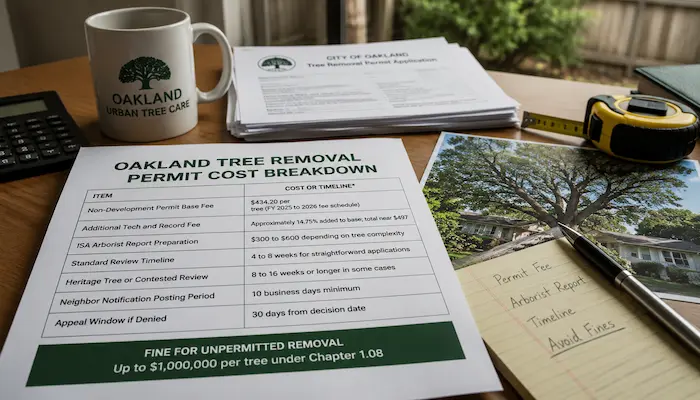
Item | Cost or Timeline |
Non-Development permit base fee | $434.20 per tree (FY 2025 to 2026 fee schedule) |
Additional tech and record fee | Approximately 14.75% added to base; total near $497 |
ISA arborist report preparation | $300 to $600 depending on tree complexity |
Standard review timeline | 4 to 8 weeks for straightforward applications |
Heritage tree or contested review | 8 to 16 weeks or longer in some cases |
Neighbor notification posting period | 10 business days minimum |
Appeal window if denied | 30 days from decision date |
Fine for unpermitted removal | Up to $1,000,000 per tree under Chapter 1.08 |
The total out-of-pocket cost for a standard permit, including the arborist report and permit fee, typically runs between $750 and $1,200 for a straightforward residential application. That cost needs to be weighed against a maximum penalty of $1 million per violation, mandatory replanting at city-specified ratios, and potential impact on future building permits and property sales. The math is not complicated.
In April 2026, Oakland City Council took up the case of Matthew Bernard and Lynn Warner, property owners on Claremont Avenue who removed 38 trees from a hillside lot between 2021 and 2022 despite multiple documented warnings from city staff, police, and neighbors that permits were required. An Oaklandside report from April 2026 documented the city council’s deliberations over whether to enforce or reduce fines approaching $1 million. As of the reporting date, the council had not reached a final decision, but the case had already become one of the most widely cited examples of Oakland’s tree ordinance enforcement in the city’s history.
The property owner did apply for a permit in June 2021, after 30 trees had reportedly already been cut. That application was later withdrawn and resubmitted through a tree company. The city rejected it for incomplete information. Years later, the lot remained vacant with a development notice posted at the bottom. The tree enforcement action had become a lien on the property that complicated the owners’ plans to build a single-family home.
This case illustrates the practical reality of Oakland’s enforcement posture: violations create encumbrances that follow the property, complicate future development plans, and generate enforcement actions that can span years. The cost of the permit that was never properly obtained is now dwarfed by the cost of the enforcement action that followed
The Three Mistakes That Always Make Things Worse Starting work before the permit is approved. Even applying for a permit does not authorize work to begin. The approval must be in hand before any tree crew starts. Withdrawing an application and resubmitting through a different party. This signals evasion to the Bureau of Planning and typically results in heightened scrutiny of the new application. Assuming the tree is exempt without professional confirmation of species. Many coast live oaks and bay laurels have been removed by homeowners who believed they were eucalyptus or non-native species. Professional identification is the only reliable way to confirm exemption status. |
.
Permit approval is not guaranteed, but a well-prepared application with a thorough arborist report documenting the justification for removal is approved in the majority of residential cases involving dead, diseased, or hazardous trees. When approval comes, it typically includes conditions.
Almost every approved Oakland tree removal permit includes a condition requiring replacement planting. The replacement ratio is set by the Tree Reviewer and depends on the species and size of the removed tree. A common starting condition is a one-to-one replacement with a 15-gallon container tree planted within a specified timeframe, usually 90 days of removal completion. For larger heritage specimens, replacement requirements can involve multiple trees or a payment into the city’s tree canopy fund in lieu of direct planting. Our tree planting and urban tree care service handles all replacement planting as part of the permit completion process, ensuring you fully satisfy the approval conditions and close the enforcement file.
Permit conditions typically specify that stumps be ground or treated to prevent resprouting within 30 days of removal. Our stump grinding and removal service is coordinated with every permitted removal job we handle, ensuring the stump treatment condition is satisfied on the same mobilization.
The Bureau of Planning may conduct a post-removal inspection to confirm the tree was removed as approved and that replacement planting is on track. Having documentation of the completed work, including photographs of the stump treatment and replacement tree installation, is the best protection against a compliance dispute after the fact.
The right sequence for any Oakland property owner considering tree removal on their property follows a straightforward path that protects you at every stage.
At Oakland Urban Tree Care, we manage this entire process for our clients. From the initial species identification and arborist report through permit submission, removal, stump grinding, and replacement planting, our team handles every step with the Bureau of Planning. We know Oakland’s permit process, we know its reviewers, and we know what a well-prepared application looks like. If you have a tree on your Oakland property that you are concerned about, start with a call. Our ISA-certified arborists will tell you exactly what you are dealing with, what is required, and what the most practical path forward looks like for your specific situation.
Call Oakland Urban Tree Care: +1 510 726 2544
