Quick Answer After a storm damages or topples a tree on your Oakland property, do these six things in order: stay back from downed power lines and call PG&E immediately; assess the scene from a safe distance without touching anything; photograph all visible damage before any cleanup begins; call a licensed 24-hour emergency tree service in Oakland; contact your homeowners’ insurance company to open a claim; and do not attempt any DIY removal on large or partially attached wood. Storm-damaged trees hold unpredictable tension in broken limbs and compromised root plates. Every year in the East Bay, serious injuries happen when homeowners approach fallen trees they thought were stable. The right call is always a certified arborist first. |
Oakland is no stranger to storms. Diablo wind events tear through the East Bay Hills each fall and winter with gusts that routinely exceed 50 mph. Atmospheric river storms roll in from the Pacific between November and April, saturating soils for weeks until root systems lose their grip on hillside properties from Montclair to Claremont. When those forces combine with Oakland’s towering eucalyptus groves, aging Monterey pines, and decades-old coast live oaks, the result is often a tree emergency that demands immediate, professional action.
This guide walks you through exactly what to do in the hours and days after a storm damages trees on your Oakland property, what the biggest mistakes are that make a bad situation worse, and how to navigate insurance documentation, permit requirements, and the decision to remove versus restore a storm-damaged tree. If you are dealing with an active emergency right now, call our 24-hour emergency tree removal line and we will dispatch a certified crew to your property as quickly as possible.
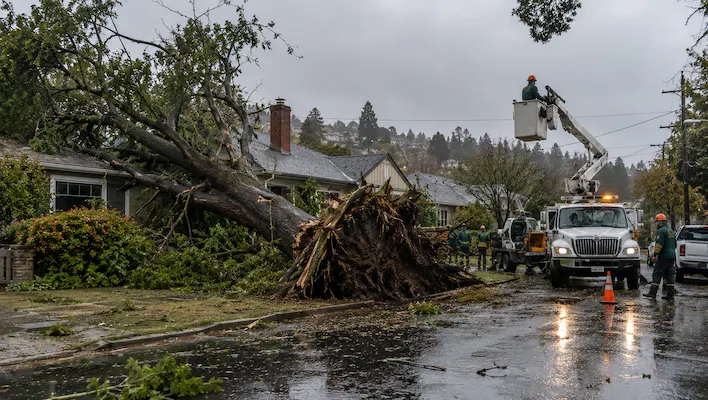
Oakland’s storm risk profile is specific, layered, and genuinely more complex than most California cities. Understanding why helps you make faster, better decisions when the next weather event hits.
Diablo winds are dry, hot, northeast winds that develop rapidly over the East Bay Hills, typically between September and January. Unlike the wet winter storms most people associate with tree damage, Diablo events strike with little warning, bring almost zero humidity, and produce sustained gusts that routinely exceed 50 mph on exposed hillside properties. Trees that have not had their canopies thinned act as sails in these conditions. The combination of maximum wind load and fire-dry wood is responsible for many of the most serious tree failures in Oakland’s Montclair, Piedmont, Rockridge, and Claremont neighborhoods every year.
Between November and April, Oakland is repeatedly hit by atmospheric river storms, narrow bands of concentrated moisture flowing from the tropical Pacific. The February 2024 atmospheric river event produced winds exceeding 90 mph in the East Bay Hills, downed thousands of trees across Alameda County, and knocked out power to hundreds of thousands of PG&E customers. When these storms arrive after weeks of prior rainfall, soils are already fully saturated. Saturated soil dramatically reduces the lateral resistance of root systems. Trees that have stood safely for decades can uproot without warning when wind pushes against them in waterlogged ground. This is why post-atmospheric-river tree failures are so common even on trees that appeared healthy before the storm.
Oakland’s urban forest includes species with specific storm failure characteristics that every homeowner on tree-dense streets should understand. Eucalyptus trees, concentrated heavily in the Oakland Hills and throughout East Bay neighborhoods, are notorious for shedding enormous limbs without warning, a behavior arborists call sudden limb failure or summer branch drop, though it occurs year-round. Monterey pines become structurally compromised as they age past 50 to 60 years, and Oakland has a significant population of aging specimens. Coast live oaks with co-dominant stems, a structural defect where two major trunks of equal size share a single attachment point, are among the most common sources of catastrophic failure in post-storm cleanup calls across Rockridge, Temescal, and the Grand Lake neighborhood
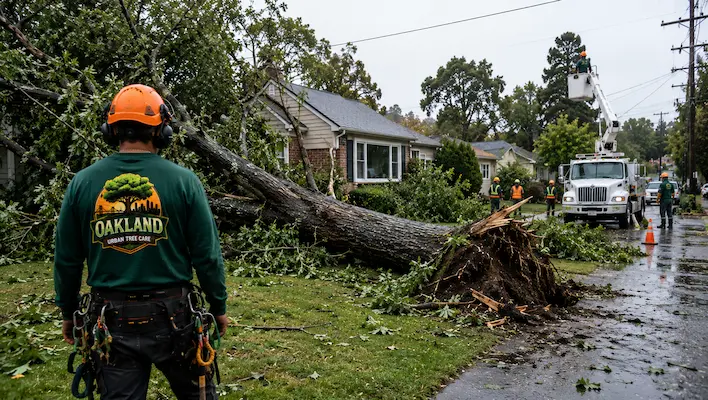
The immediate aftermath of a storm is the most dangerous window for property owners. The temptation to go outside and assess the situation is understandable, but several hazards that are not visible until you are too close make rushing out after the storm passes a serious risk.
If a tree has fallen on or near power lines, assume the lines are energized and do not approach. Do not attempt to move the tree or clear a path. Contact PG&E’s emergency line at 1-800-743-5000 immediately and keep all people and pets away from the area until utility crews confirm the line is de-energized. Downed power lines can energize the ground around them in a radius that is not visible. Many serious electrical injuries occur to people who approach downed lines that appear inactive.
After a storm passes, large broken branches can be lodged in the canopy of an otherwise standing tree. These widow makers, so called because of their history of killing workers and bystanders who approach without looking up, can fall minutes, hours, or even days after the storm passes. Before entering your yard or property, look up through the entire canopy of every tree in the area and look for broken wood that is suspended rather than lying on the ground. Do not walk beneath any canopy until a certified arborist has cleared it.
A tree that has been pushed over but not fully uprooted contains enormous stored energy in its root plate and trunk. The root ball may be partially lifted, with soil and roots under significant tension. If the remaining root connections give way, the root ball can slam back down with lethal force in a wide radius. Keep everyone well back from any partially uprooted tree and treat it as an active emergency requiring professional response.
Never Do This After a Storm Do not start a chainsaw on a fallen tree before a certified arborist assesses it. Storm-damaged wood contains unpredictable tension in the compressed lower fibers and stretched upper fibers of every broken limb. A chainsaw cut that releases this tension without knowing its direction can send wood snapping violently toward the operator. This is the most common cause of serious injury in post-storm DIY cleanup, and it happens every year in the East Bay. |
The 30 minutes you spend photographing storm damage before any cleanup begins can make a meaningful difference in your insurance claim outcome. Once debris is moved, the evidence of how and where the tree fell, what it hit, and what the pre-removal condition of the surrounding structures was cannot be recreated.
Beyond photos, write a brief description of the sequence of events: what you observed during the storm, what time you first noticed the damage, whether anyone witnessed the tree fall, and the approximate height and species of the tree. Your insurance adjuster and our arborists will both find this information useful. Our storm damage cleanup team provides a written assessment of the damage as part of our emergency response, which is formatted to support insurance claims.
After ensuring safety and documenting the damage, your next call is to a licensed, insured emergency tree removal company in Oakland. Not all tree services offer genuine 24-hour emergency response. Look specifically for companies that confirm their availability, send a crew rather than just a scheduler, and employ ISA Certified Arborists who can perform an on-site risk assessment when they arrive.
When you call, give the following information clearly and quickly: your address and the nearest intersection; whether a power line is involved; whether the tree is on a structure or vehicle; whether any access routes to the tree are blocked; and whether there are overhead hazards in the canopy. This lets the crew prepare the right equipment before they arrive and helps dispatch triage true emergencies from situations that can safely wait a few hours.
When Oakland Urban Tree Care responds to a storm emergency, we perform an immediate site safety assessment before any cuts are made, identify all tension and compression forces in the downed wood, secure the scene against secondary hazards, execute the removal with equipment appropriate to the access and debris load, document the removal with photographs suitable for insurance purposes, and provide full site cleanup so the property is safe and accessible when we leave. Our emergency tree removal service is available 24 hours a day, every day of the year, including during and after major storm events when demand is at its highest.
Homeowners often worry that Oakland’s tree removal permit requirements will prevent them from responding quickly to a genuine emergency. In practice, there is a fast-track process for trees that have already failed or present an imminent and documented hazard to life or property. A certified arborist’s written assessment documenting the emergency condition supports this process. We manage the notification and documentation requirements as part of our emergency response, ensuring your removal is handled legally from the first call to the last log.
Storm-related tree damage is among the most common homeowners’ insurance claims in Oakland and throughout Alameda County. Filing correctly and promptly significantly affects the outcome of your claim.
Most standard California homeowners’ insurance policies cover tree removal costs when a covered peril, such as a windstorm, causes the tree to fall and the tree damages a covered structure including your home, garage, fence, or shed. Coverage for the removal typically ranges from $500 to $1,000 per tree when structural damage is involved. If the tree falls into your yard without striking a structure, most policies do not cover the removal costs.
One exception worth knowing: if a fallen tree blocks a driveway, wheelchair ramp, or other required access point to the property, some policies cover removal even when the tree did not strike a structure. Review your policy’s specific language on blocked access before assuming a yard-only fall is not claimable.
This is where claim complications most commonly arise. If an insurance adjuster or inspector determines that the fallen tree was already dead, severely diseased, or visibly hazardous before the storm event, the insurer may argue that you had prior knowledge of a dangerous condition and failed to act, potentially reducing or denying the claim. This is one of the most compelling practical arguments for proactive tree health assessments and documented removal of dead or deteriorating trees before storm season begins in November. A history of professional tree care is your best defense against a negligence argument in a claim dispute.
One fallen tree after a storm is a signal, not an isolated event. The conditions that caused one tree to fail, saturated soil, high wind loading on an unmanaged canopy, co-dominant structural defects, or pre-existing disease, are almost certainly present in other trees on the same property. After the immediate emergency is resolved, schedule a post-storm tree health assessment of your entire property’s canopy.
Not every storm-damaged tree needs to come down. A tree that has lost a significant limb but maintains a sound trunk and healthy root system can often be restored through targeted pruning of the damaged wood, cleaning of wound edges to support callus formation, and structural assessment to confirm no hidden decay entered through the wound. Our tree pruning team specializes in post-storm restoration pruning that gives salvageable trees the best chance of recovery. The decision to remove versus restore is made by an ISA Certified Arborist based on the percentage of canopy lost, the structural integrity of the remaining trunk and scaffold, evidence of internal decay or root damage, and the tree’s location relative to structures it could threaten in a future event.
Every major storm event in Oakland generates the same pattern: a surge of emergency calls from properties where the conditions that caused the failure were visible months before the storm arrived. Proactive maintenance, performed before storm season begins, is dramatically more cost-effective than emergency response after the fact.
Task | Why It Matters |
Crown thinning | Reduces wind resistance by up to 40%, lowering the force on trunk and root plate |
Dead wood removal | Eliminates the branches most likely to become projectiles in high winds |
Co-dominant stem cabling | Reinforces structurally weak attachment points before wind stress tests them |
Root zone inspection | Identifies root plate compromise before saturation makes it worse |
Crown reduction | Reduces leverage on overextended limbs near structures |
Tree health assessment | Documents tree condition for insurance purposes before the season begins |
The ideal pre-storm maintenance window in Oakland is September and October, before the first Diablo wind events and before winter atmospheric rivers begin saturating soils. This timing allows crown thinning and structural work to be completed while trees are still in their late-summer condition, wounds begin sealing before the wet season, and any permits needed for protected trees can be processed before the highest-risk weather arrives. Our tree trimming and tree cabling and structural support teams are at peak availability in late summer and early fall for exactly this reason.
For properties in Oakland’s Wildland-Urban Interface zone, including the Oakland Hills, Montclair, and areas above Highway 13, Cal Fire’s defensible space requirements mandate vegetation clearance in a 100-foot radius around structures. This includes removing dead wood, pruning low branches that could carry ground fire into the canopy, and eliminating direct fuel paths between trees. Annual compliance inspection by Oakland Fire Department crews means non-compliant properties receive formal notices. Our team manages all aspects of defensible space tree work for Oakland Hills properties, from initial assessment through compliance documentation.
After a major storm, Oakland sees a surge of door-to-door solicitation from out-of-area tree crews who flood in from surrounding counties to offer discounted emergency work. This is a well-documented pattern following every significant Bay Area storm event. These crews frequently lack current California C49 licensing, do not carry workers’ compensation insurance, and disappear once paid, leaving homeowners exposed to liability if an injury occurred on their property or the work was performed incorrectly.
At Oakland Urban Tree Care, we are fully licensed, insured, and ISA-certified. Our emergency response team is locally based in the East Bay and available 24 hours a day for storm events. We do not subcontract emergency work to out-of-area crews. When you call us during a storm, you get our team, our equipment, and our certification, every time.
Storm damage rarely affects only one tree or one service category. Oakland Urban Tree Care handles every stage of the storm recovery process:
Storm Emergency? Call Oakland Urban Tree Care 24/7: +1 510 726 2544
