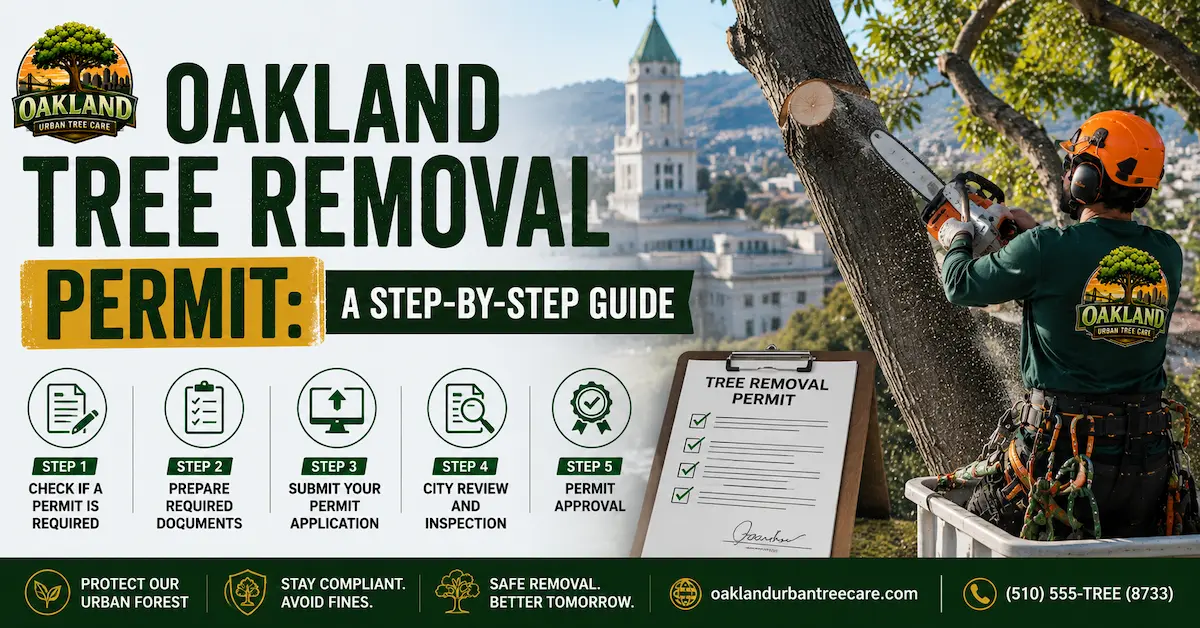
Getting a tree removal permit in Oakland, CA requires submitting a Non-Development Tree Removal Permit application through the city’s Online Permit Center, paying a minimum fee of $580.71 plus a 14.75% technology surcharge, and waiting for a site inspection and approval from the Oakland Tree Services Division before any work begins. Permits are mandatory for most protected trees and are non-refundable once paid. Many property owners work with professional tree removal services to help navigate permit requirements, inspections, and safe tree removal procedures more efficiently.
If you own property in Oakland and have a tree you want to take down, this process is not optional. The city takes its tree protection laws seriously seriously enough that in May 2026, Oakland’s City Council voted to impose a record fine of over $915,000 on a single property owner for illegally removing 38 protected trees without permits. That is not a scare tactic; that is exactly what can happen when homeowners skip the process.
This guide walks you through every step, explains who needs a permit and who does not, covers the specific rules around Oakland’s most protected tree species, and tells you what to do if your application gets denied.
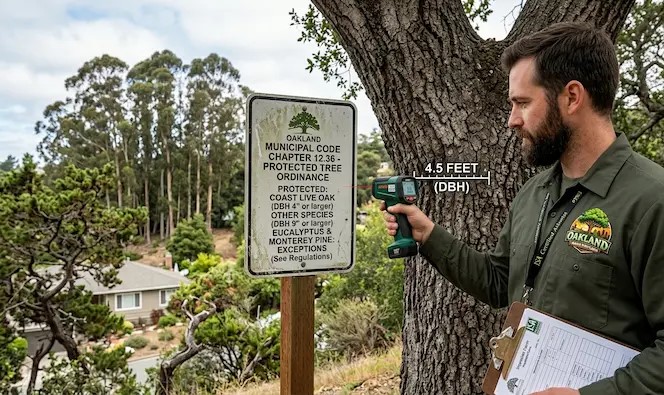
Before anything else, you need to determine whether your tree is actually protected under Oakland Municipal Code Chapter 12.36, commonly called the Protected Tree Ordinance. Not every tree in the city requires a permit to remove, but many do. In some cases, the city may recommend alternatives such as Tree Trimming or Tree Pruning instead of full removal, especially when a tree can still be preserved safely through proper maintenance and structural care. Property owners researching removal requirements in other locations may also find guidance from Tree Removal Albany NY, although Oakland homeowners must always follow local city regulations.
Under this ordinance, a tree is considered protected if it falls into one of these categories:
Coast Live Oak (Quercus agrifolia): Any oak with a trunk diameter of four inches or more, measured at four and a half feet above the ground. This measurement is called diameter at breast height, or DBH. Oakland’s coast live oaks are among the most fiercely protected trees in the city’s urban forest, and removing one without authorization can trigger enforcement action.
All Other Tree Species: Any tree with a trunk DBH of nine inches or larger is protected, with the notable exception of eucalyptus trees and Monterey pines.
Eucalyptus Trees: These are the one major exception. Eucalyptus trees can be removed without a standard removal permit. However, given their known fire risk in the Oakland Hills, always confirm current regulations with the city before removal, as local fire ordinances may still apply.
Monterey Pine (Pinus radiata): Monterey pines occupy a middle ground. They are not protected under the standard tree ordinance on private property, but the city requires written notification to the Office of Parks and Recreation before any Monterey pine is removed. You must identify the address, the number of trees, and their size in writing and send it to the Tree Reviewer at 7101 Edgewater Drive, Oakland, CA 94621.
If you are unsure of your tree’s species or DBH, an ISA Certified Arborist can assess the tree and provide that information. Consulting one before you apply can also strengthen your case when the city inspector arrives.
Oakland distinguishes between two categories of tree removal permits, and applying for the wrong one will delay your project.
Non-Development Tree Removal Permit: This is the permit most residential homeowners need. It applies to any tree on public or private property, including front yards, backyards, and trees in the public right of way, when no construction project is involved. This is the permit described throughout this guide.
Development-Related Tree Removal Permit: If you are removing a tree as part of a construction project — anything that requires a separate zoning permit, building permit, grading permit, or demolition permit — you need the development-related version instead. In those situations, the tree removal permit application must be filed simultaneously with the City Planning Department alongside your other project permits. Any protected tree within ten feet of a proposed building footprint also triggers this requirement.
Getting this distinction right from the start saves significant time.
The Non-Development Tree Removal Permit application is available through Oakland’s Online Permit Center at oaklandca.gov. Here is how to access it:
You can also request a paper application by calling the Oakland Tree Services Division at (510) 615-5934 during business hours, which are Monday through Friday, 8:00 a.m. to 3:30 p.m. The division is located at the Tree Division office at Building 4, 7101 Edgewater Drive, Oakland, CA 94621.
For specific questions about the online process, you can also email treeremovalpermits@oaklandca.gov.
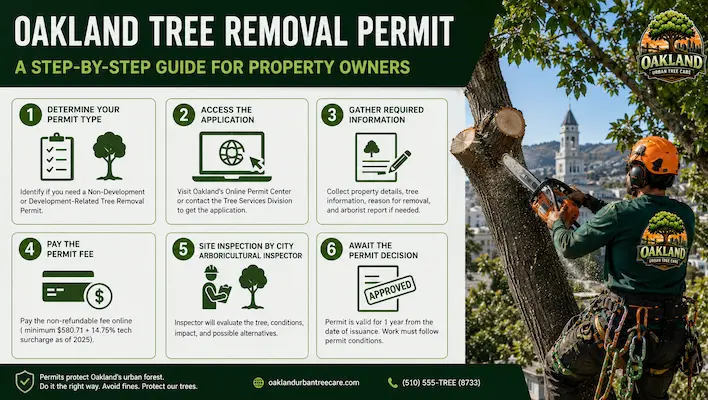
One of the most common reasons applications get delayed or denied is incomplete information. Before you start filling out the form, gather the following details:
Your information: Full legal name, mailing address, phone number, and email.
Property details: The address of the property where the tree is located, along with the Assessor’s Parcel Number (APN), which you can find on your property tax bill or through the Alameda County Assessor’s office.
Tree-specific information for each tree you want to remove:
Reason for removal: This field carries significant weight in the city’s review. Valid reasons include hazardous condition (disease, structural failure risk, leaning toward a structure), interference with construction, interference with utilities, or confirmed pest infestation such as sudden oak death. Vague reasons like “we don’t like the tree” or “it drops leaves” are unlikely to result in approval for a protected species.
Arborist Report: If you are requesting removal of five or more trees on the same permit application, Oakland requires a written report from a Certified Arborist on the city’s approved arborist list. Even for fewer trees, attaching an ISA Certified Arborist’s assessment of the tree’s condition dramatically improves your application’s chances of approval, particularly for coast live oaks.
Oakland’s non-development tree removal permit fees are not small, and they are non-refundable regardless of whether your application is approved or denied. As of 2025, the minimum fee is $580.71 plus an additional 14.75% technology surcharge, bringing the total to approximately $665 at minimum.
Fees can increase based on the number of trees included in the application and the complexity of the review process. Payment is made through the Online Permit Center at the time of application submission.
The non-refundable nature of these fees makes it worth doing your homework before you apply. Consulting with a certified arborist beforehand to confirm that your reason for removal is documentable and legitimate can save you from paying the fee only to receive a denial.
Step 5: Site Inspection by the City’s Arboricultural Inspector
After your application and payment are submitted, the Oakland Tree Services Division will schedule a site inspection. A city employee classified as an Arboricultural Inspector, Tree Supervisor I, or Tree Supervisor II will visit your property to assess the tree firsthand.
During the inspection, the inspector will evaluate:
For properties on steep hillside terrain, inspectors pay close attention to erosion control and drainage impact. If the property is significantly sloped, you may be asked to submit a drainage plan alongside your application before the permit is issued.
Be present during the inspection if possible. The inspector may have questions about the tree’s history or your intentions, and your ability to answer them directly can support your case.
After the inspection, the Tree Reviewer will prepare findings and issue a decision. Oakland permits are valid for one year from the date of issuance, meaning any removal work must be completed within that window. If the permit expires before work is done, you will need to reapply and pay the fee again.
If your application is approved, you will receive a formal permit document. Work must begin and be completed under the conditions stated in that permit. Deviating from the approved scope, such as removing more trees than permitted, is treated as a violation of the ordinance.
A denial does not have to be the end of the road. Under Oakland Municipal Code Section 12.36.110, you have the right to appeal a non-development permit denial to the Park and Recreation Advisory Commission.
To file an appeal, you must do so within the timeframe specified in your denial letter and pay a separate appeal fee as set by the city’s master fee schedule. The Commission is required to issue a final decision within 30 working days of your appeal date. If no decision is reached within that window, the original denial is considered affirmed.
Common grounds for a successful appeal include new information, such as a recent arborist assessment confirming disease progression, an updated drainage plan for hillside properties, or evidence that the tree poses an imminent structural risk.
Oakland recognizes that some situations require urgent action. If a tree on your private property poses an immediate hazard to life or property, the permit process and associated fees can be waived under the Hazardous Tree Ordinance (Oakland Municipal Code 12.40).
To request a permit waiver for a hazardous tree, contact the Public Works Call Center at (510) 615-5566 between 8:00 a.m. and 4:30 p.m. An inspector from Tree Services will respond within 48 hours. Only the property owner can request this waiver. You cannot request a waiver to remove a tree that belongs to a neighbor.
This is where things get serious. Oakland enforces its tree protection laws aggressively, and the consequences of unpermitted removal are severe.
Property owners who remove protected trees without a permit face fines calculated based on the appraised replacement value of each tree removed. In a landmark 2026 case, Oakland’s City Council voted to uphold a fine of over $915,135 against a property owner who illegally removed 38 protected trees, including coast live oaks, bigleaf maples, and a California buckeye, from a hillside property in the Oakland Hills. The city had issued multiple written and verbal warnings before the trees were taken down, and the property owner still proceeded without authorization.
Beyond the fine, all development-related permits on a property where unauthorized tree removal occurred can be placed on hold, effectively freezing any construction or renovation plans until the violation is resolved.
Who to contact: Oakland Tree Services Division, (510) 615-5934, treeremovalpermits@oaklandca.gov
Where to apply: Oakland Online Permit Center, oaklandca.gov
Minimum permit fee: $580.71 plus 14.75% technology surcharge (non-refundable)
Inspection: Required before permit is issued
Permit validity: One year from issuance date
Protected species requiring a permit: Coast live oak at 4+ inches DBH; all other species at 9+ inches DBH (except eucalyptus)
Hazardous tree waiver: Call (510) 615-5566 for same or next-day inspection
Ordinance reference: Oakland Municipal Code Chapter 12.36 (Protected Trees) and Chapter 12.40 (Hazardous Trees)
Every step of this process goes more smoothly when you have an ISA Certified Arborist involved early. An arborist familiar with Oakland’s Protected Tree Ordinance can confirm whether your tree requires a permit, document its condition accurately, prepare any required arborist reports, and help you avoid the costly mistake of submitting an incomplete application.
The International Society of Arboriculture (ISA) maintains a publicly searchable database of certified arborists. When hiring a tree removal contractor in Oakland, always verify that they are licensed by the California Contractors State License Board (CSLB), carry liability insurance and workers’ compensation coverage, and ideally hold ISA certification.
Oakland’s urban forest is one of the city’s most valued environmental assets. The permit process exists to protect it. Working through the system correctly the first time keeps your project moving, your property clean, and your finances intact.
