
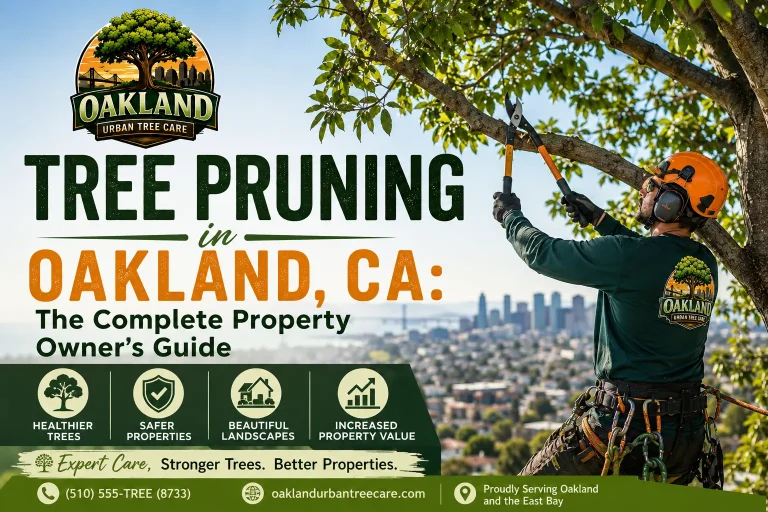
What is the difference between tree pruning and tree trimming? Trimming controls size and shape for aesthetics and clearance. Pruning is a targeted, health-focused practice removing specific branches to improve structure, fight disease, or eliminate hazards. Can over-pruning kill a tree? Yes. Removing more than 25% of live canopy in a single season causes physiological stress that weakens the tree’s immune system, triggers harmful epicormic sprouting, and can lead to irreversible decline over 2–5 years. What is structural pruning? Structural pruning shapes young trees to establish one dominant central leader, well-spaced scaffold branches, and strong attachment angles — setting up a stable framework that prevents costly hazards at maturity. When is the best time to prune trees in Oakland, CA? Late fall through winter (November–February) is optimal for most species. Oak trees must never be pruned April–July due to Sudden Oak Death risk in the East Bay. Does pruning reduce storm damage? Yes. Crown thinning reduces wind loading by 30–50%, crown reduction removes leverage from overextended limbs, and removing dead wood eliminates the most likely failure points before storms arrive. 1. Tree Pruning vs Tree Trimming — What’s the Real Difference?“Pruning” and “trimming” are used interchangeably by many Oakland homeowners — and even by some tree service companies that should know better. They describe fundamentally different activities with different goals, different techniques, and different outcomes for the tree. Understanding the distinction protects you from hiring a crew that delivers the wrong service, and from approving work that could damage trees worth thousands of dollars. Tree Trimming: Controlling Size, Shape, and ClearanceTrimming is primarily a practical and aesthetic service. It removes branches that have grown beyond a desired boundary overhanging a roof, blocking a driveway, encroaching on a neighbor’s property, or growing into a power-line corridor. The goal is controlling the tree’s physical footprint and preventing interference with surrounding structures. Our tree trimming service in Oakland addresses these clearance and shape objectives on a regular maintenance schedule. The work is largely defined by the structure around the tree rather than the tree’s internal biology. A crew performing trimming cuts to a clearance, not to a branch collar. Tree Pruning: A Targeted Horticultural PracticePruning involves making deliberate, selective cuts to specific branches based on a careful assessment of the tree’s structure, health, and growth patterns. Every pruning cut has an explicit purpose: removing dead or diseased wood, correcting a structural defect, improving light distribution through the canopy, or redirecting growth away from a developing hazard. Pruning requires knowledge of tree biology, species-specific growth habits, wound compartmentalization, and disease transmission dynamics. Our Oakland tree pruning specialists are ISA-certified arborists who understand not just where to cut, but why each cut is made and what the tree’s biological response will be in the weeks, months, and years that follow. Side-by-Side Comparison
In practice both services are often performed in the same visit. A qualified Oakland Urban Tree Care arborist will assess what the tree actually needs clearance trimming in one area, structural pruning in another and execute both in a coordinated session. The distinction matters most when hiring: insist the company explains what they are doing and why before a single cut is made. 2. Why Proper Pruning Improves Long-Term Tree HealthPruning is often perceived as a subtractive act you are removing something from the tree. In reality, proper pruning is one of the most constructive interventions available in tree care. Each well-placed cut activates the tree’s biological wound response, redirects energy to productive tissue, and sets the tree up for stronger, more efficient growth in the years that follow. The cumulative health benefits of regular, skilled pruning over a tree’s lifetime are profound. Stopping Disease and Decay Before They SpreadDiseased branches are not simply dead weight they are active biological vectors. Fungal pathogens and bacterial infections spread through the tree’s vascular system and through shared soil contact with root grafts. Removing infected branches promptly, with clean cuts made just outside the branch collar, isolates the problem before it reaches the main trunk or root crown. This is especially important in Oakland given the documented presence of Sudden Oak Death (Phytophthora ramorum) throughout the East Bay, which has killed tens of thousands of coast live oaks across Northern California. Pairing timely pruning with a professional tree health assessment gives you the earliest possible warning of disease entry, and the best chance of intercepting it before it becomes a removal decision. Redirecting the Tree’s Energy to Where It MattersA tree allocates its photosynthetic energy budget across all living tissue including dead, dying, and structurally redundant branches that are consuming resources without contributing to the tree’s productive growth. Removing unproductive wood through pruning redirects that energy to the tree’s strongest, most active growing zones. The results are visible: more vigorous new growth, better fruit production in fruiting species, and a canopy that fills out more evenly over successive seasons. Improving Light Penetration and Photosynthetic EfficiencyThe interior of a mature tree’s canopy is frequently shaded to the point where inner branches receive insufficient light to photosynthesize meaningfully. These light-starved branches gradually weaken, die, and add to the deadwood load that creates hazard risk. Crown thinning the selective removal of interior branches to open up the canopy structure restores light to inner foliage, allowing the tree to maintain productive tissue throughout its canopy depth rather than only in the outermost shell of growth. The result is a healthier tree that requires less corrective intervention over time. Reducing Pest and Fungal Disease PressureDense, poorly aerated canopies create the humid, stagnant conditions that allow fungal spores to germinate and pest populations to establish. Borers, scale insects, and spider mites thrive in shaded, crowded canopies where airflow is poor and natural predators struggle to access them. Fungal diseases including powdery mildew, anthracnose, and Cercospora leaf spot are all significantly more prevalent in trees with insufficient airflow through the crown an ongoing concern in Oakland’s fog-influenced coastal neighborhoods. Strategic pruning opens the canopy, speeds post-rain drying of leaf surfaces, and dramatically reduces the conditions that allow these problems to gain a foothold. Extending the Tree’s Productive LifespanTrees that receive consistent, skilled pruning throughout their lives routinely live and produce for decades longer than unpruned trees in equivalent conditions. A coast live oak on a well-maintained Oakland property can live 200–300 years. The same species neglected until structural failure or disease takes hold may be lost in 50. Regular tree pruning, combined with tree health monitoring and structural cabling support where appropriate, is the most comprehensive longevity program available for Oakland’s urban trees. 3. Structural Pruning Explained for Oakland Property OwnersStructural pruning is the most technically demanding and most impactful form of tree care and for most Oakland homeowners it is also the least familiar. Performed on young to semi-mature trees, structural pruning establishes the architectural framework that will define the tree’s form, strength, and safety for its entire life. Getting it right in the early years is the single most cost-effective investment you can make in your trees. What Structural Pruning Sets Out to AchieveA structurally sound tree displays several defining characteristics. Structural pruning works to establish and reinforce all of them:
The Critical Window: First 15–20 YearsThe formative pruning window is the first 15–20 years of a tree’s life. Corrective cuts during this period are small, heal within a single growing season, and redirect growth before structural problems become permanent features of the tree. Waiting until a tree reaches full maturity to address structural defects means making large cuts on old wood wounds that may never fully callus, leaving the tree permanently vulnerable to decay at the wound sites. The practical approach is an annual or biennial inspection during the first decade, with light structural cuts as needed to reinforce good form. By year 15, the structural skeleton should be essentially correct and future maintenance can shift to the lighter crown cleaning appropriate for mature trees. |
Not every tree on an Oakland property was well-planted or properly cared for in its early years. If you have a tree aged 10–25 years showing co-dominant stems, included bark, or significant canopy imbalance, structural correction is still achievable but it must unfold gradually across multiple seasons. Attempting to correct years of structural neglect in a single aggressive pruning session removes too much live wood and causes the same physiological stress as over-pruning. A qualified ISA-certified arborist will develop a multi-year correction plan that brings the tree toward sound structure incrementally, protecting its health throughout the process.
The trees that fail most catastrophically in Oakland’s storm events whole-trunk splits, root plate failures, large-limb drops are almost always trees that developed structural defects that were never corrected. Co-dominant stems, included bark, and severely unbalanced canopies are reliably the pre-existing conditions in post-storm failure analyses. Structural pruning, combined with tree cabling and bracing support for the most compromised specimens, is the most direct investment an Oakland property owner can make in protecting their home and family from tree-related storm damage.
Yes definitively. Over-pruning is one of the most common, most damaging, and most persistently misunderstood mistakes in residential tree care across Oakland and the wider East Bay. The problem is that its effects are not immediately obvious: a freshly over-pruned tree may look “cleaned up” to an untrained eye on the day of the cut, while the biological damage that will eventually kill it is already underway.
Trees produce their energy through photosynthesis converting sunlight into sugars within their leaves. The more leaf area a tree maintains, the more photosynthesis it can perform and the more energy it has available for growth, wound response, pest resistance, and immune function. When pruning removes a moderate portion of canopy generally accepted as up to 25% in a single season the tree compensates by directing more resources to the remaining leaves and increasing photosynthetic efficiency per unit of leaf area.
When more than 25% of the live canopy is removed in one session, the tree cannot compensate. It enters a state of acute physiological stress, drawing down its stored carbohydrate reserves in the root system to survive. This reserve depletion is the mechanism through which over-pruning compromises the tree’s immune function and creates a cascade of secondary damage that can extend for years.
If any crew uses the words “topping,” “hat-racking,” “de-horning,” or offers to “gut” a tree’s interior, end the conversation and hire someone else. These are not alternative pruning styles they are harmful practices universally condemned by the International Society of Arboriculture (ISA) and consistently documented to result in structural failure, disease, and death. They are frequently offered by unlicensed, uninsured crews who bear no responsibility for the long-term consequences to your trees or property. The 25% Rule in PracticeThe widely accepted professional guideline is to remove no more than 25% of a tree’s live canopy in a single pruning session. For most mature Oakland shade trees this means the work done in any given year is measured and targeted removing dead wood, correcting a specific structural issue, making necessary clearance cuts not dramatically reshaping the tree’s overall silhouette. If you have a tree that genuinely requires more than 25% reduction to address a hazard or site conflict, an experienced arborist will develop a plan spread over two or three seasons. Recovering an Over-Pruned Oakland TreeIf a tree on your property has been over-pruned by a previous owner or an unlicensed crew, recovery is possible but it takes years of careful management. Start with a professional tree health assessment to evaluate the extent of physiological stress and identify any disease or pest problems that have taken advantage of the tree’s compromised immune status. Recovery involves allowing the tree to rebuild canopy through a full growing season, then selectively removing the weakest epicormic sprouts those with the poorest structure and attachment while retaining those best positioned to eventually form new permanent scaffold branches. Full recovery typically requires 3–5 years to restore meaningful canopy and 10+ years to approach the tree’s pre-damage structural form. 5. Seasonal Tree Pruning Guide for Oakland, CAOakland’s Mediterranean climate warm, dry summers from June through October and mild, wet winters from November through Apri creates a pruning calendar that differs from most of the United States. Understanding Oakland’s seasons, and how different tree species respond to the work at different times of year, is foundational to getting good outcomes and avoiding avoidable damage. Winter (November – February): The Primary Pruning WindowWinter dormancy is the optimal pruning window for the majority of Oakland’s tree species. The biological advantages compound each other: the absence of foliage on deciduous trees reveals the full branch architecture, making structural assessment far more accurate; wound compartmentalization is most effective when it begins just before the spring growth flush; and pest and disease activity is at its annual low point, reducing the risk of pathogens entering fresh pruning cuts. For most large-scale structural work, crown reduction, and any work on oak trees, late fall through winter is the only recommended window. Spring (March – May): Light Maintenance OnlySpring is when Oakland’s trees invest stored energy in producing new leaves, flowers, and shoots. Pruning during this period removes growth the tree has already expended resources to produce, adding unnecessary stress during what should be the tree’s most energetically productive period. Spring pruning should be limited to:
Heavy structural work, crown reduction, and significant canopy modifications should always wait for the winter window. Summer (June – October): Hazard Removal and Fire PreparationOakland’s dry season is not the optimal time for major pruning heat and drought stress increase the physiological burden of open wounds. However, specific situations require summer intervention: branches identified as immediate falling hazards must be removed regardless of season; storm damage cleanup after any unseasonal wind event cannot wait; and crown thinning and dead-wood removal for fire-season defensible space preparation in hillside neighborhoods the Oakland Hills, Montclair, Rockridge, Claremont is both recommended and in some cases legally required under Cal Fire defensible space standards. Summer pruning must be performed by experienced professionals who can make clean, collar-preserving cuts that minimize wound size and optimize the tree’s healing response under stress conditions. Species-Specific Seasonal Pruning Guidelines
6. Crown Reduction Pruning — When and Why It’s NeededCrown reduction is among the most frequently requested pruning services in Oakland and among the most frequently performed incorrectly. Done properly it is one of the most effective tools for managing large trees in constrained urban settings while preserving the tree’s health and structural integrity. Done incorrectly, it produces the same devastating outcome as topping, despite being performed under a more palatable name. What Proper Crown Reduction Actually InvolvesTrue crown reduction is the selective reduction of individual branch lengths by cutting each branch back to a suitable lateral branch one that is at least one-third the diameter of the removed segment. This technique, known as the “drop-crotch” or “lateral branch” method, shortens branches while maintaining the tree’s natural branching pattern. Each cut terminates at a growing lateral that the tree can use to continue canopy development from the cut point. The defining difference from topping is what happens after the cut: in proper crown reduction, the tree continues normal growth from the retained lateral branches. In topping, cuts are made to arbitrary points with no living lateral remaining, forcing the tree into epicormic survival-sprouting mode. The visual result initially looks similar a smaller crown but the biological outcomes are entirely different. When Crown Reduction Is the Right Choice
Crown Reduction vs. Crown Thinning: Which Does Your Tree Need?Crown reduction and crown thinning are distinct techniques, appropriate for different situations. Understanding the difference will help you communicate accurately with your arborist:
For most mature Oakland trees that are healthy but have become overly dense, thinning is the preferred approach. Crown reduction is reserved for situations where reducing the tree’s physical size is genuinely necessary not simply because someone finds the tree “too big.” How Much Reduction Can Be Done at Once?The 25% live canopy guideline applies equally to crown reduction. Even when a significant size reduction is genuinely needed a 50-foot tree that needs to reach 35 feet, for example achieving that goal across two or three seasons produces far less physiological stress than attempting it in a single aggressive session. Our ISA-certified Oakland arborists develop multi-season reduction plans that achieve the homeowner’s objectives while keeping the tree healthy and structurally sound throughout the process. If you are also concerned about a tree’s internal structural weaknesses, tree cabling and structural support can be installed in conjunction with the reduction plan to manage risk while the crown work unfolds. 7. How Pruning Reduces Storm Damage RiskOakland’s storm exposure is significant and varied. Winter atmospheric river events bring sustained heavy rainfall that saturates soils for weeks, dramatically reducing root anchorage strength. Diablo wind events dry, powerful northeast winds that develop rapidly in fall and early winter regularly produce gusts exceeding 50 mph across East Bay hillside neighborhoods. Every significant wind event in Oakland generates property damage and emergency calls, the vast majority of which involve trees with structural problems that pre-existed the storm. Strategic, preventive pruning combined with tree cabling and structural bracing for the most vulnerable specimens is the most effective risk-reduction intervention available to Oakland property owners. Wind Loading: Understanding the PhysicsWhen wind moves through a tree canopy, the branches, leaves, and overall canopy structure present resistance to the moving air. This resistance, quantified as “wind loading,” is broadly proportional to the density and volume of the canopy. A large, dense, untrimmed canopy encountering a 50-mph Diablo wind event experiences enormous lateral forces. Those forces travel from branches to the trunk and from the trunk to the root plate. If the wind load exceeds the structural capacity of any element in this chain a weak branch attachment, a root plate weakened by waterlogged soil, a trunk with internal decay that element fails. Crown thinning directly reduces wind loading by allowing wind to pass through the canopy rather than push against it as a solid wall. Research studies on urban crown thinning have consistently measured reductions in wind loading of 30–50% in thinned trees compared to unthinned controls. In practical terms for Oakland’s hillside neighborhoods: thinning a dense mature eucalyptus or pine before Diablo wind season meaningfully reduces the probability of branch or whole-tree failure in subsequent events. Removing Structural Failure Points Before Storms DoPruning specifically targets the categories of defects most likely to fail in storm conditions:
Soil Saturation and Root Anchorage: The Winter-Specific RiskOakland’s winter rain season introduces a compounding storm-damage risk factor that is absent in the summer Diablo wind pattern: saturated soils. When Oakland soils are fully saturated after weeks of atmospheric river rainfall, their ability to hold root plates against lateral wind forces decreases dramatically. Trees with already-compromised root systems damaged by construction excavation, root rot, or long-term soil compaction from foot traffic or paving are at acute risk of full uprooting in these conditions. A tree health assessment that evaluates root zone condition is an important component of storm-season preparation for any large tree, particularly those in saturated hillside zones. Crown reduction for trees with confirmed root system compromise reduces both the wind-sail area of the canopy and the total weight the root system must support — a meaningful storm-risk reduction intervention. Post-Storm Pruning: Restoring Trees After DamageStorm damage creates urgent pruning needs of its own. Broken branches, split stems, and partially attached limbs left in place after a storm are not merely cosmetic problems they are structural hazards, disease entry points, and sources of ongoing bark-tearing damage as they move in subsequent winds. The jagged wounds left by storm breakage lack the clean geometry of proper pruning cuts and heal far more slowly. Post-storm pruning converts storm damage into clean, collar-preserving cuts that minimize ongoing wound size and give the tree the best chance of sealing the damage in the coming growing season. If you have storm damage, contact our storm damage cleanup and emergency tree service team as soon as conditions are safe. And consider scheduling a full post-storm pruning assessment of the remaining canopy storms often reveal structural weaknesses in adjacent branches that were previously hidden under normal load conditions. Protecting Oakland’s Trees — One Precise Cut at a TimeProper tree pruning is among the highest-return investments an Oakland property owner can make in their trees not because results are immediately visible, but because the benefits compound steadily across years and decades. A tree precisely pruned during its youth develops into a safer, stronger, more beautiful specimen at maturity. A mature tree correctly maintained through regular professional pruning lives longer, resists Oakland’s disease pressures more effectively, and survives the Bay Area’s most demanding storm events with less damage than one that has been neglected or improperly handled. The difference between a tree that becomes a priceless neighborhood landmark and one that becomes a removal project is often a handful of correct, well-timed cuts made at the right point in the tree’s development. At Oakland Urban Tree Care, our ISA-certified arborists bring deep knowledge of Oakland’s tree species, disease environment, regulatory requirements, and climate conditions to every pruning project. Whether you need structural shaping for a young tree, crown reduction for a mature specimen that has outgrown its space, dead-wood removal for winter storm preparation, or a whole-property canopy risk assessment, we are here to help. Explore our complete range of services: tree p runing · tree trimming · tree cabling & structural support · tree health assessment · emergency tree removal · storm damage cleanup · stump grinding & removal · tree planting & urban tree care. Contact us today for a free estimate.
|
 Quick Answers
  Warning Sign: These Practices Are Never Acceptable
 Call Oakland Urban Tree Care Free Estimate: +1 510 726 2544
 Visit OaklandUrbanTreeCare.com