
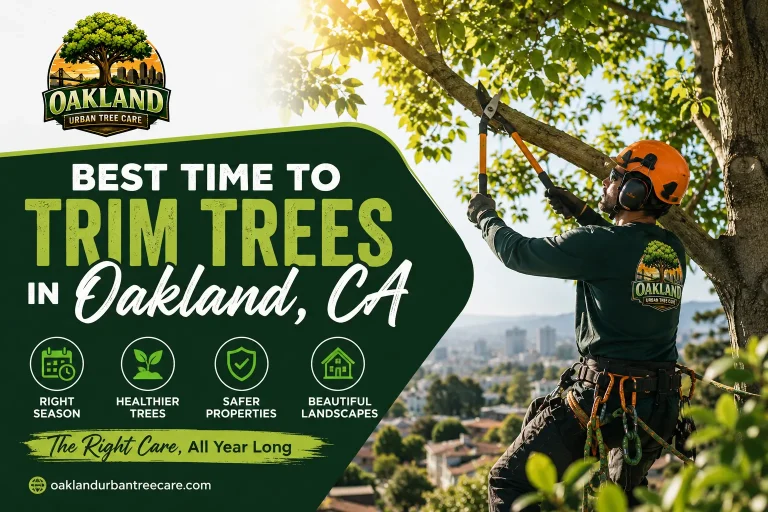
People also ask about tree trimming in Oakland When is the best time to trim trees in Oakland? Late fall through winter (November–February) is generally best for most species, when trees are dormant. However, dead or hazardous branches should be removed immediately, any time of year. How often should trees be trimmed? Most mature trees need trimming every 3–5 years. Young trees benefit from annual shaping. Fast-growing species near power lines or structures may need attention every 1–2 years. Is tree trimming the same as pruning? No. Trimming focuses on aesthetics and safety — removing overgrown or excess growth. Pruning is more targeted, removing specific diseased, dead, or structurally weak branches to improve tree health. Do I need a permit to trim trees in Oakland? For routine trimming of trees on your own property, a permit is generally not required. However, protected species like coast live oaks may require approval from the City of Oakland before significant work is done. |
Oakland’s Mediterranean climate — warm, dry summers and mild, wet winters — creates a unique rhythm for tree care that differs from most of the United States. Understanding that rhythm is the first step toward keeping your trees healthy year-round.
For the majority of tree species in Oakland, late fall through winter is the optimal window for trimming. During this period, trees have dropped or significantly slowed their growth, making them less vulnerable to the stress caused by cutting. The biological reasons are straightforward: when a tree is dormant, it directs less energy to its outer branches and more to its root system. Removing branches during this window means the tree expends less energy healing the cut wounds and is less susceptible to disease or pest infestation entering through open cuts.
This window is also ideal from a logistical standpoint. With leaves absent from deciduous trees, arborists can clearly see the branch structure, identify crossing or rubbing limbs, and make more precise cuts. For Oakland homeowners concerned about the visual outcome of trimming, dormant-season work often produces cleaner, more balanced results. Similar seasonal tree care practices are recommended by professionals across the country, including specialists providing JCS TREES services, where proper timing plays a key role in maintaining tree health and reducing long-term risks.
Spring is when Oakland’s trees push new growth — fresh buds, emerging leaves, and an explosion of canopy energy. Trimming during this phase removes energy the tree has already invested in producing new growth, which can stress the tree unnecessarily. That said, spring trimming is not harmful if done lightly. Dead branches, crossed limbs, and any growth interfering with structures can be safely addressed. If you are looking for deeper crown work, however, wait for summer or the next dormant season. For proactive care, scheduling a tree health assessment in spring before growth peaks is an excellent practice.
Oakland’s dry season, running roughly June through October, is not the ideal time for heavy trimming — but it is the right time for certain situations. If a tree has grown too close to your home’s roofline or is shading solar panels, summer is a practical time to address it. Summer also reveals which branches are struggling: any limbs showing wilting, sparse leaf coverage, or unusual discoloration mid-summer are signaling stress, disease, or structural weakness and should be addressed promptly.
Oakland’s dry, hot summers also increase wildfire risk, particularly in elevated neighborhoods like the Oakland Hills, Montclair, and Joaquin Miller. Trimming back overhanging branches away from your home and removing dead wood during this window is a critical component of fire season preparation.
Not all trees follow the same schedule. Here are trimming timing notes for the most common Oakland tree species:
One of the most common questions Oakland homeowners ask is how frequently their trees need professional attention. The answer depends on the species, the tree’s age and location, and what goals you have for the trimming — safety, aesthetics, health, or all three.
Beyond species, where a tree sits on your property affects how often it needs attention:
Scheduled trimming is the ideal approach, but some situations demand immediate action regardless of timing. If you notice large hanging dead branches — commonly called “widow makers” — storm damage, severe lean, or signs of active disease spreading through the crown, contact a certified arborist for an urgent tree health assessment without delay. In these cases, the risk to your property and safety outweighs any seasonal timing consideration.
Trees don’t announce when they need care — but they do show clear signs if you know what to look for. The following indicators mean your Oakland trees need professional trimming soon, and in some cases, immediately.
If you identify any of these warning signs, schedule a professional consultation. Our tree trimming service in Oakland includes a full safety assessment before any cuts are made.
Regular professional trimming is not just a cosmetic choice — it is one of the highest-return investments an Oakland property owner can make. The benefits span safety, financial value, tree health, and community.
Every year in Oakland, falling branches and trees cause property damage, vehicle damage, and personal injury. Many of these incidents are preventable with routine trimming that removes dead wood, corrects structural imbalances, and eliminates hanging limbs before they fall. This is especially critical in neighborhoods with overhead power lines and in hillside communities where large eucalyptus and pine trees grow over homes. In emergencies, our 24-hour emergency tree service is available to address urgent situations — but prevention is always preferable.
Well-maintained trees add measurable value to Oakland residential properties. Studies consistently show that mature, healthy trees can increase property values by 5–15%. Conversely, overgrown, damaged, or neglected trees can detract from a home’s appearance and be flagged during real estate inspections. Regular trimming keeps your trees looking structured, healthy, and intentional — an important factor in Oakland’s competitive real estate market.
A trimmed tree is a healthier tree. Removing dead, diseased, and crossing branches prevents decay from spreading through the tree’s vascular system. It also improves airflow through the canopy, which reduces the humidity and moisture retention that encourages fungal disease — a significant concern given Oakland’s fog-heavy microclimates in neighborhoods like Rockridge and the Laurel District. Regular trimming works hand-in-hand with professional tree health assessments to keep your trees living for decades longer.
Oakland’s devastating 1991 firestorm remains one of the deadliest urban wildfires in California’s history. The risk has not diminished — if anything, drought cycles have made East Bay trees more flammable. Trimming removes dead, dry wood that acts as kindling, creates horizontal separation between trees to slow fire spread, and maintains defensible space around structures. For hillside properties, this is not optional — it is a legal requirement under Cal Fire regulations.
Overgrown trees block sunlight to gardens, secondary structures, and increasingly important in Oakland, rooftop solar panels. A strategic trimming session can restore productive sunlight to vegetable gardens, reduce lawn die-off under dense shade, and significantly improve solar panel output — sometimes recovering thousands of dollars in electricity generation annually.
Oakland’s Municipal Code requires property owners to maintain trees so that branches do not encroach on city sidewalks below 8 feet or create traffic sight-line obstructions. Failure to maintain this clearance can result in fines and liability for any injuries caused by non-compliant growth. Our team handles all city code compliance issues as part of our Oakland tree trimming service.
DIY tree trimming is common — and commonly done wrong. The following mistakes not only fail to help trees but can cause lasting structural damage, invite disease, and create safety hazards far worse than the original problem.
“Topping” — cutting the main trunk or primary branches back to stubs — is arguably the single most damaging practice in tree care. It is still widely done by unlicensed crews offering cheap work, and it is still devastating. Topping removes the majority of a tree’s leaf area in one cut, forcing the tree into survival mode. The result is an explosion of weakly attached, fast-growing water sprouts that are more dangerous than the original growth, a severely stressed tree that is far more susceptible to disease, decay, and death, and ultimately a tree that may need to be fully removed within 5–10 years. Topping does not make a tree safer — it makes it more dangerous.
Every branch connects to the trunk at a slightly swollen area called the “branch collar” — a zone of specialized cells the tree uses to seal off wounds. Cutting flush against the trunk removes the branch collar, destroying the tree’s ability to seal the wound. The result is a large open wound that invites decay fungi, bacteria, and boring insects directly into the tree’s vascular core. Always cut just outside the branch collar, leaving a small stub of the collar intact.
“Lion-tailing” refers to the practice of stripping all interior foliage and branches from limbs, leaving tufts of growth only at the tips — like a lion’s tail. This throws the tree’s weight distribution to the outer ends of branches, dramatically increasing the risk of limb failure in wind events. It also removes the interior foliage that shades the bark, leading to sunscald and additional stress. Never remove more than 25% of a tree’s live canopy in a single season.
As mentioned earlier, trimming oak trees between April and July in the East Bay increases the risk of Sudden Oak Death. The Phytophthora ramorum pathogen is spread by sap beetles that are most active during this period. Fresh pruning cuts attract these beetles, which carry the disease from infected trees to healthy ones. If you have coast live oaks or other oak species on your Oakland property, always work with an arborist who understands local disease protocols. Our tree health assessment service includes oak disease screening as a standard component.
Trimming decisions should account for the health of the root system. A tree with compromised roots — from soil compaction, root rot, or construction damage — cannot handle the same level of canopy work as a tree with a healthy root system. Before undertaking significant trimming on a large or mature tree, a professional assessment of root health is worthwhile. Signs of compromised roots include leaning, crown dieback starting at the top, and fungal growth at the base.
Dull or dirty tools crush branches rather than cutting them cleanly, creating ragged wounds that take far longer to seal. Dirty tools — particularly those used on diseased trees — can spread pathogens from one tree to another. Professional arborists sterilize cutting tools between trees, particularly when working around oak trees given the Sudden Oak Death risk in Oakland.
Many Oakland homeowners hire the cheapest crew they can find for tree trimming, not realizing that unlicensed tree workers carry significant liability risk. If an unlicensed worker is injured on your property, your homeowner’s insurance may not cover the claim. Beyond insurance, unlicensed crews rarely have the horticultural knowledge to make cuts that benefit the tree’s long-term health. Always hire an ISA (International Society of Arboriculture) certified arborist. Our team at Oakland Urban Tree Care is fully licensed, insured, and ISA-certified.
One of the most important distinctions in tree care is understanding that young and mature trees require fundamentally different approaches. The goals, techniques, and timing for each are not interchangeable.
The work done on a young tree in its first few years of life determines its structural integrity for decades. This phase is called “structural training” or “formative pruning,” and it involves making deliberate, corrective cuts to guide how the tree grows.
The primary goals when trimming young Oakland trees are:
Young trees should be inspected and lightly shaped annually. The cuts are small, the wounds heal quickly, and the long-term structural benefits are enormous. Neglecting this phase is the single biggest cause of expensive, hazardous structural problems in mature trees.
Mature trees have established their structural form. Aggressive shaping at this stage is not only unnecessary but harmful. The goals for trimming mature Oakland trees shift significantly:
Large, mature trees also require more careful wound management. A 3-inch cut on a young tree heals in a season. A 3-inch cut on a 50-year-old tree may take 5–10 years to fully callus over, if it ever does. This is why correct cutting technique — just outside the branch collar, clean and perpendicular to the branch — is even more critical on mature specimens.
Trees in this middle range are transitioning from formative pruning to maintenance pruning. The structural “skeleton” is largely set, but there is still meaningful opportunity to correct developing problems before they become permanent. This is often the most cost-effective window for crown reduction work and addressing any structural defects that appeared during the rapid growth phase.
Among the less-discussed but highly practical benefits of regular tree trimming is its direct impact on the microclimate of your Oakland property — specifically the amount of sunlight reaching your home and landscape, and the quality of airflow through the canopy.
A healthy tree canopy is not a solid wall of leaves — it is a layered, permeable structure that allows a portion of sunlight to filter through. When a canopy becomes over-dense through years of untrimmed growth, light penetration drops significantly. This has cascading effects across your entire property:
Crown thinning — the selective removal of interior branches to open up the canopy — restores light penetration without removing the tree’s overall form or shade value. A well-executed thinning pass can increase light penetration by 20–40% while maintaining the visual scale and character of the tree.
Oakland sits at the interface of several distinct microclimates — marine fog flowing in from the bay, warmer inland air from the Central Valley, and the elevated cool-air zones of the Oakland Hills. This creates environments where moisture can persist on tree leaves and branches for extended periods, particularly in neighborhoods close to the Bay or in shaded hillside canyons.
Stagnant, moisture-heavy air inside a dense canopy is a breeding environment for fungal diseases, including:
Crown thinning improves wind movement through the canopy, drying leaf surfaces more quickly and dramatically reducing the conditions that allow fungal spores to germinate and spread. This is one reason why a tree health assessment often recommends structural trimming as the first line of defense against recurring fungal issues — before any chemical treatments are considered.
An overly dense canopy acts as a sail in wind events, dramatically increasing the load on the trunk and root system. Oakland experiences periodic Diablo wind events — dry, powerful winds coming from the northeast — that routinely damage trees, particularly those with dense, untrimmed canopies. Crown thinning reduces “wind loading” by allowing wind to pass through the canopy rather than push against it as a solid mass. Crown reduction — selectively removing the outermost growth to reduce overall canopy volume — is also highly effective for large trees in exposed positions. Together, these techniques can significantly reduce the risk of whole-tree failure in storm events, which is one of the leading causes of property damage in Oakland’s hillside neighborhoods.
Many Oakland homeowners cultivate California native plants, drought-tolerant Mediterranean gardens, and vegetable beds that require specific light conditions. An overgrown tree that shifts a garden from “dappled shade” to “deep shade” can devastate plantings that took years to establish. Strategic trimming — lifting the canopy base, reducing crown density on one side, or selectively removing specific limbs — can be done with precision to restore the exact light environment your garden needs without compromising the tree’s health or appearance.
Oakland’s trees are one of the city’s most defining and valuable assets. From the ancient oaks of the Montclair hills to the neighborhood liquidambars lining Piedmont Avenue’s sidewalks, these trees are irreplaceable — they take decades to grow and can be lost in an afternoon if neglected. Regular, professional tree trimming is the most direct investment you can make in preserving them for the long term.
Whether you need routine crown maintenance, emergency limb removal, structural training for young trees, or a comprehensive assessment of your entire property’s tree canopy, Oakland Urban Tree Care is here to help. Our ISA-certified arborists bring deep local knowledge of Oakland’s unique species, climate, regulations, and fire-risk context to every job. Explore our full range of services, including tree trimming, tree pruning, stump grinding and removal, emergency tree service, storm damage cleanup, and tree health assessments. Contact us today for a free estimate and let our team bring expert, professional care to every tree on your property.
 Call Oakland Urban Tree Care for a Free Estimate Today: +1 510 863 7085
 Visit OaklandUrbanTreeCare.com